
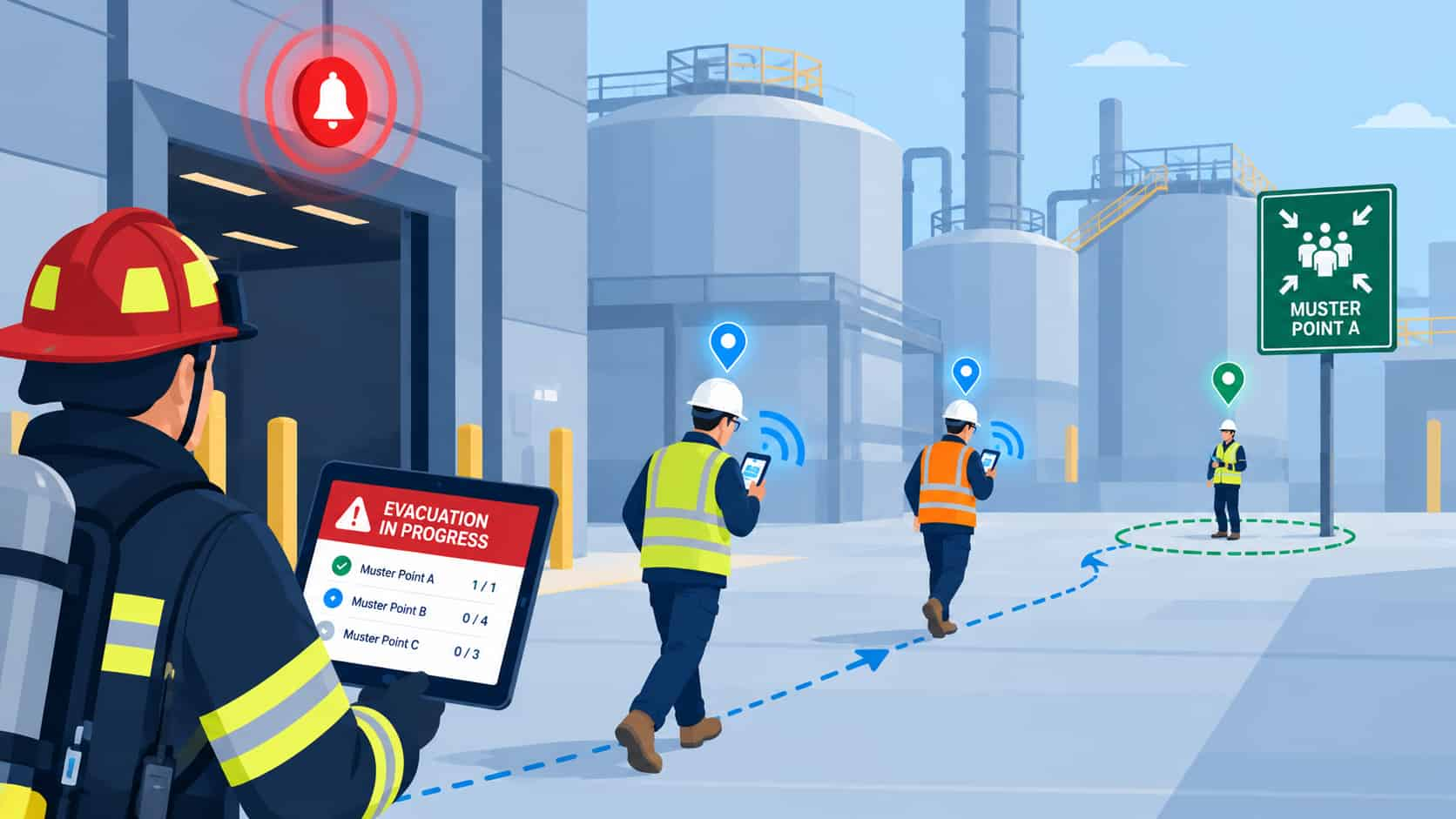
What is Automated On-Site Worker Safety?
Real-Time Worker Location Monitoring, Hazardous-Zone Detection, and Automated Safety Workflows
Fluid Mobility automates on-site worker safety by combining Real-Time Location Systems (RTLS), Bluetooth Low Energy (BLE), GPS geofencing, mobile devices, and context-aware automation. The FLUID platform monitors worker location and safety-related events to trigger hazard notifications, digital safety checklists, duress alerts, and incident response workflows, helping organizations protect personnel and improve workplace safety.
What Common Challenges does Automatic Worker Safety Address?
Organizations operating industrial facilities, construction sites, manufacturing plants, and other hazardous environments must protect workers while maintaining visibility into changing workplace conditions.
Traditional safety procedures often rely on manual inspections, periodic check-ins, radio communications, and workers identifying and reporting hazards themselves. These approaches can delay the detection of safety concerns and make it difficult to coordinate timely responses.
Four common worker safety problems include:
How Does Fluid Mobility Automate Worker Safety?
Fluid Mobility automates on-site worker safety by detecting worker location and safety-related context, evaluating predefined operational conditions, and triggering appropriate safety and incident response workflows.
The FLUID platform uses indoor RTLS, BLE-enabled wearables, mobile devices, GPS geofencing, and compatible connected systems to support worker safety monitoring across indoor and outdoor environments.
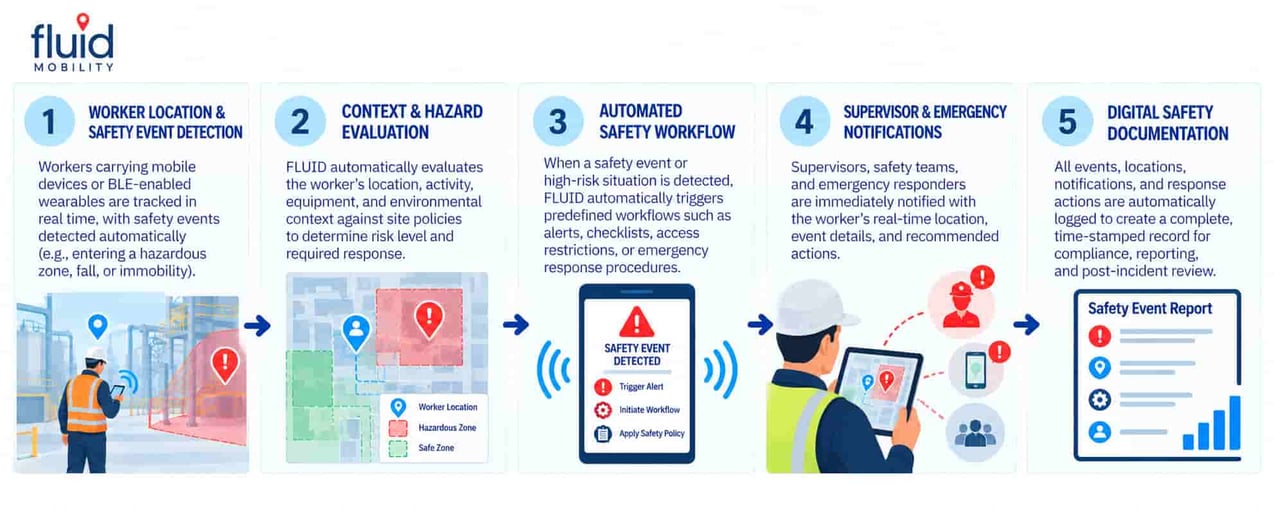
The FLUID Five-Step Worker Safety Workflow:
Organizations managing a workforce across their premises must maintain visibility into who is where, where equipment is located, and whether workers have entered authorized or restricted areas.
Five-Step Worker Safety Workflow
|
Step |
Technical Process |
On-Site Worker Safety Example |
|
1. Detect Context |
Collect worker location, movement, inactivity, proximity, and emergency signals from RTLS, BLE wearables, GPS geofences, mobile devices, or connected systems. |
A maintenance technician carrying a BLE-enabled device enters a designated hazardous work zone. |
|
2. Evaluate Conditions |
Compare real-time worker context against predefined safety rules, hazardous-zone boundaries, worker roles, and operational requirements. |
FLUID identifies that the technician has entered an area requiring additional safety procedures. |
|
3. Trigger Automated Actions |
Initiate configured safety alerts, digital checklists, hazard notifications, worker check-ins, path to muster zones, and other incident response workflows. |
FLUID automatically dispatches a location-specific safety checklist to the technician's mobile device. |
|
4. Notify Responders |
Send relevant safety events, available worker location information, and unresolved alerts to designated supervisors or response personnel. |
A supervisor receives a notification if the worker reports a hazard or a required safety acknowledgment remains incomplete. |
|
5. Record & Report |
Document configured safety events, notifications, acknowledgments, completed checklists, and response activities. |
The zone-entry event, safety acknowledgment, and relevant timestamps are recorded for review. |
What are the Benefits of FLUID Worker Safety?
Automated on-site worker safety improves hazard awareness, emergency response coordination, and operational consistency by transforming real-time location and contextual data into automated safety workflows.
|
Feature |
Capability |
Business Benefit |
|
Real-Time Worker Location & Movement Monitoring |
Monitor available worker location and movement data across indoor and outdoor environments using RTLS, BLE-enabled wearables, mobile devices, and GPS geofencing. |
Improve worker visibility, identify unexpected movement or prolonged inactivity, and help safety personnel locate workers when assistance is required. |
|
Automated Hazardous-Zone Detection & Safety Alerts |
Detect when workers enter designated hazardous areas, cross restricted geofences, or approach locations requiring additional safety precautions. |
Improve hazard awareness, deliver timely safety notifications, and reduce reliance on manual monitoring and intervention. |
|
Context-Aware Safety Checklists & Incident Response Workflows |
Evaluate worker location, role, time, and safety events to automatically dispatch digital checklists, request worker acknowledgments, or initiate incident response procedures. |
Improve consistency of safety procedures, reduce administrative coordination, and accelerate safety-related communications. |
|
Digital Safety Documentation & Audit Trails |
Record configured location events, safety notifications, worker acknowledgments, checklist completions, incident alerts, and response timestamps. |
Strengthen worker accountability, support incident investigations, and maintain digital records for workplace safety reviews and audit preparation. |
How Would Automated Worker Safety Work in a Secure Facility?
(1) Detect Context: A maintenance technician enters a designated high-risk equipment area while carrying a compatible BLE-enabled device.
(2) Evaluate Conditions: FLUID detects the technician's location through the facility's RTLS infrastructure and evaluates the event against predefined safety rules. The platform identifies that the area requires additional safety precautions.
(3) Trigger Automated Actions: FLUID automatically dispatches a digital safety checklist and location-specific hazard notification to the technician's mobile device.
(4) Notify Responders: If the technician activates a BLE duress button or a configured safety check-in remains unresolved, FLUID initiates an incident response workflow and notifies designated safety personnel with available worker location information.
(5) Record & Report: The platform records relevant zone-entry events, safety notifications, checklist acknowledgments, duress alerts, and response activities for subsequent review.
Outcome: Improved hazard awareness, more consistent safety procedures, faster emergency notifications, and reduced dependence on manual worker monitoring.