Our Core Capabilities
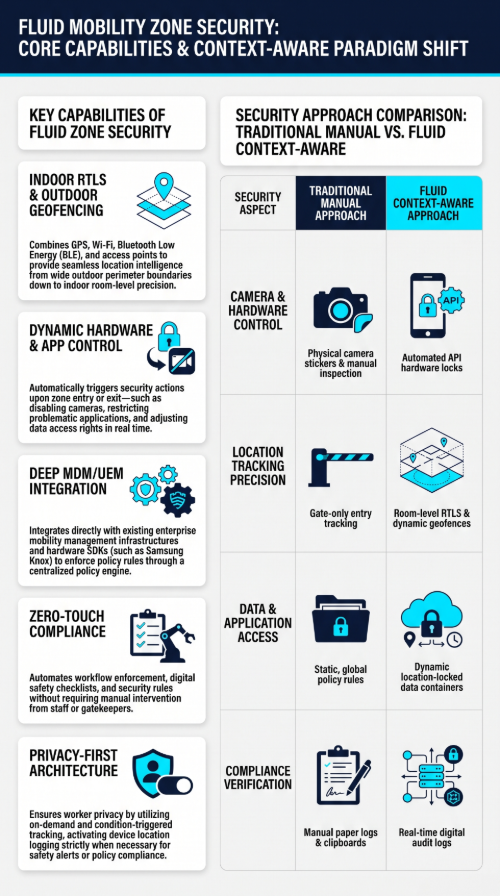
Restricted & High-Security Zone Protocol Automation automatically enforces location-based security policies on enterprise mobile devices when they enter sensitive physical perimeters. By combining indoor RTLS, GPS geofencing, and enterprise MDM/UEM integrations (including Samsung Knox and BlackBerry UEM), Fluid Mobility automatically disables camera access, restricts unapproved apps, and locks sensitive off-premise data, securing high-risk perimeters without manual security intervention.
Context-Aware Location Security
Continuously monitors device location using outdoor GPS geofencing and indoor RTLS via Wi-Fi and BLE mesh networks. Security policies are automatically enforced the moment a device enters a defined restricted zone, eliminating reliance on manual intervention or physical checkpoints.
MDM / EMM Integration
Event-triggered policy enforcement integrates directly with leading enterprise MDM / EMM platforms. Automated payloads disable hardware cameras, restrict unauthorized applications, and lock sensitive data containers upon perimeter entry.
Automated Device Compliance
Zero-touch compliance automates check-ins or security checkpoints at controlled perimeters. Devices automatically revert to standard operational profiles upon exit, ensuring continuous audit-ready compliance aligned with ISO 27001, CMMC, SOC 2 Type II, and HIPAA requirements.
How Fluid Mobility Automates High-Security Zone Protocols
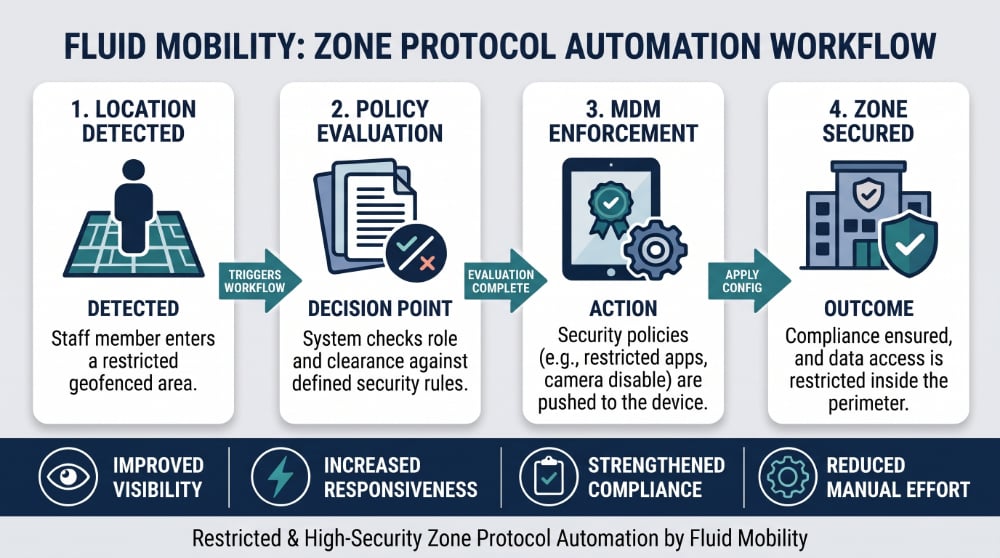
When a device crosses into a restricted perimeter, Fluid Mobility's context-aware engine immediately detects its location via indoor RTLS or outdoor geofencing, evaluates the device's security posture and user role, then pushes an automated MDM / EMM policy payload, disabling cameras, locking unauthorized apps, and restricting sensitive data containers without any manual intervention.
- Eliminates human error with API-level hardware enforcement upon zone entry.
- Delivers zero-touch compliance across BYOD, COBO, and COPE.
- Automatically restores standard device profiles the moment a user exits the secured zone.
Context Triggers & Automated Actions
|
Location Context / Signal
|
Trigger Condition
|
Automated Action
|
Security Outcome
|
|---|---|---|---|
|
Indoor RTLS / BLE Beacon
|
Device enters Server Room or Cleanroom
|
Automatically disables device camera and microphone APIs.
|
Prevent unauthorized photo or audio capture.
|
|
Polygon Geofence Boundary
|
Device crosses into R&D / High-Security Perimeter
|
Locks non-compliant messaging, social media, and cloud apps.
|
Eliminates external data leak vectors and unverified network syncs.
|
|
Location & Network Posture
|
Device exits authorized facility boundary
|
Restricts access to sensitive corporate data containers off-premise.
|
Enforces physical data sovereignty and data-at-rest protection.
|
|
Duress / Man-Down Signal
|
SOS alert activated inside restricted zone
|
Dispatches floor-level emergency beacon and live indoor pathing.
|
Rapid emergency response to exact indoor room location.
|
Frequently Asked Questions
How does Fluid Mobility maintain location tracking inside buildings where GPS is unavailable?
Fluid utilizes indoor Real-Time Location Systems (RTLS) powered by Bluetooth Low Energy (BLE) mesh networks and Wi-Fi access points to deliver precise, room-level positioning inside buildings.
Which MDM/UEM platforms integrate with Fluid Mobility for automated policy triggers?
Fluid Mobility deeply integrates with most major enterprise endpoint managers including BlackBerry UEM, Samsung Knox, Ivanti Neurons, Microsoft Intune and Jamf, allowing context-based rules to trigger MDM actions in real time.
Does this solution support Bring Your Own Device (BYOD) deployment models?
Yes. Fluid Mobility supports BYOD, COBO (Corporate-Owned Business-Only), and COPE devices by enforcing conditional security rules within isolated enterprise work containers without touching personal data.
What happens if a device loses network connectivity while inside a restricted zone?
Security policies are enforced directly at the local device agent level, ensuring hardware restrictions remain active even if cellular or Wi-Fi connectivity drops.
Can we set different security policies for overlapping zones?
Yes. Fluid supports multi-layered polygon geofences and indoor RTLS zones, enabling you to apply general policies for an entire facility and heightened restrictions for inner vaults or cleanrooms.
How does automated zone security support regulatory compliance audits?
Fluid generates automated, time-stamped digital logs of zone entries, active policy states, and compliance events, providing verifiable proof for ISO 27001, CMMC, and SOC 2 audits.
Our Recent Insights
Explore how context-aware security and mobile policy automation are reshaping high-security environments across critical industries.
10/13/2026
Automated RTLS Asset Tracking for High-Value Equipment
Automated RTLS Asset Tracking for High-Value Equipment
10/13/2026
Automated Incident Response for Field & Lone Workers
Automated incident response uses real-time location, geofencing, connected devices,and predefined...
09/16/2026
Enhancing Security, Safety, and Efficiency with Context-Aware Automation
Every day, things change. A worker starts a shift. A device enters a secure facility. Someone...
09/09/2026
What Is Context-Aware Security? And Why Does Context Matter?
Security knows who you are. But does it know what's happening around you? Security has...