
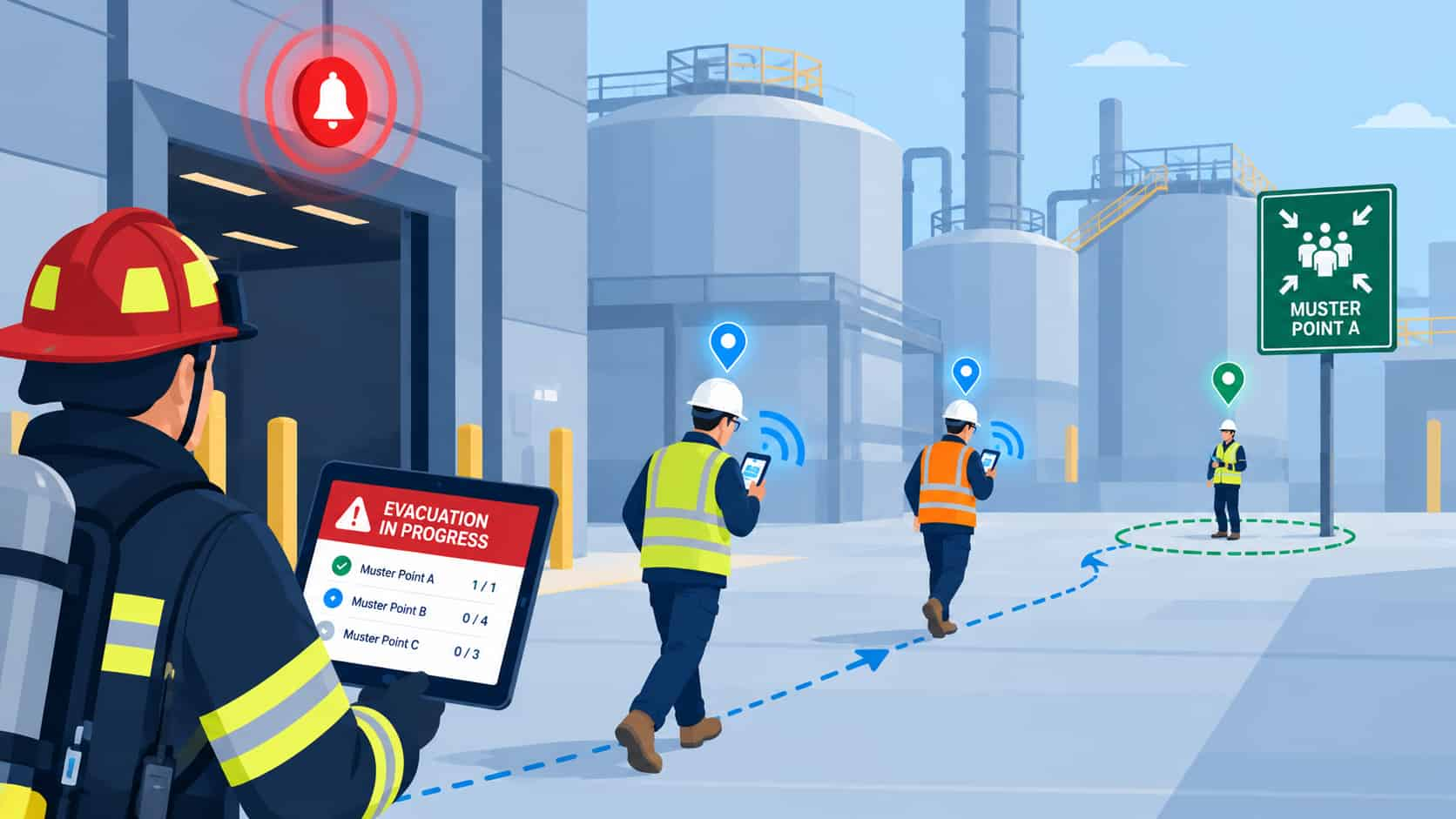
How Does Fluid Mobility Automate Emergency Mustering and Personnel Accountability?
Automated Incident Response & Field Safety, Indoor RTLS Positioning, and Real-Time Personnel Location Monitoring
Fluid Mobility automates emergency mustering by combining Real-Time Location Systems (RTLS), Bluetooth Low Energy (BLE), GPS geofencing, and context-aware workflows to help organizations locate personnel, monitor evacuation progress, and identify workers who may need assistance. The FLUID platform reduces manual headcounts, improves emergency visibility, and supports faster, more coordinated responses.
What Common Challenges does Emergency Mustering Address?
During workplace emergencies, organizations must quickly determine who is safe, who has evacuated, and who may still require assistance. Traditional emergency mustering procedures often rely on manual headcounts, paper attendance lists, radio communications, and fragmented personnel records.
These methods can delay emergency response and make it difficult to maintain accurate personnel accountability across large facilities, hazardous worksites, and remote operations.
Four common mustering problems include:
How Does Fluid Mobility Automate Emergency Mustering?
Fluid Mobility automates emergency mustering by detecting emergency events, evaluating personnel location and status against predefined rules, and initiating coordinated evacuation and accountability workflows.
The FLUID platform uses indoor RTLS, BLE-enabled wearables, mobile devices, and outdoor GPS geofencing to support personnel visibility across indoor and outdoor environments.
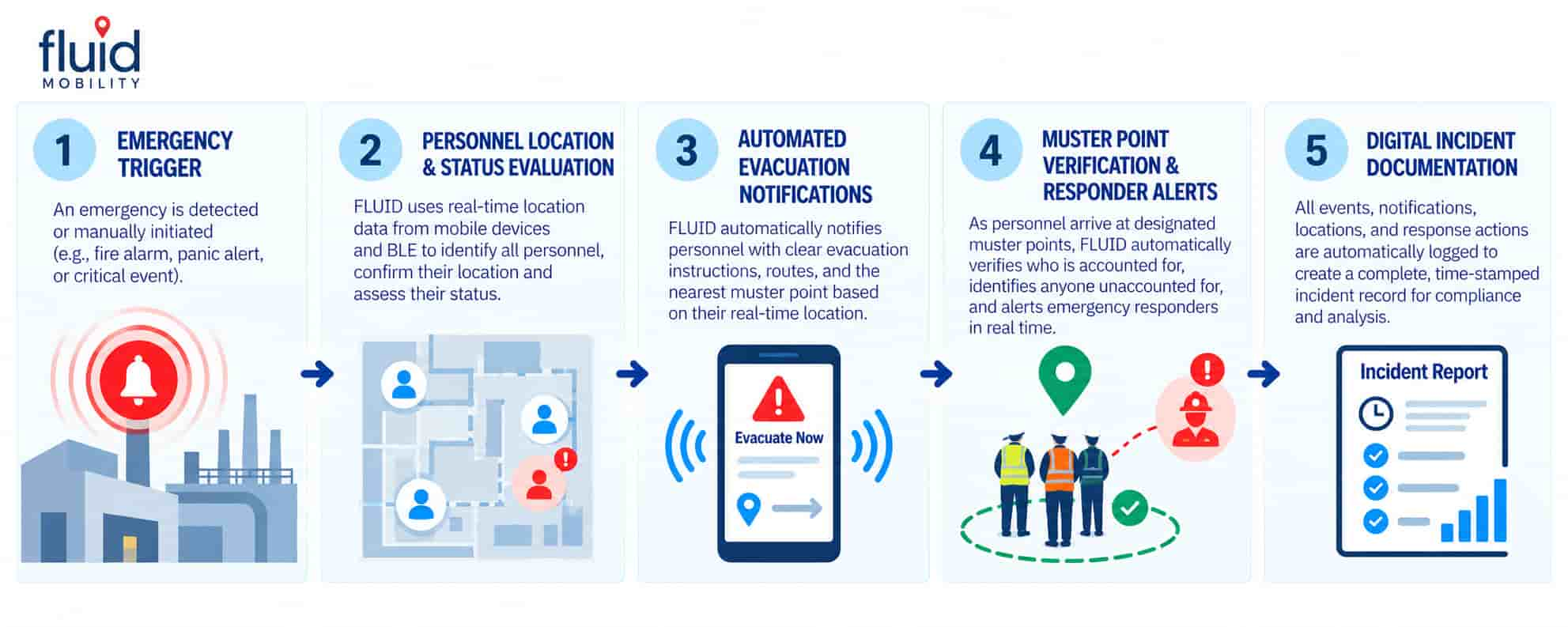
The FLUID Five-Step Emergency Mustering Workflow:
During workplace emergencies, organizations must quickly determine who is safe, who has evacuated, and who may still require assistance. Traditional emergency mustering procedures often rely on manual headcounts, paper attendance lists, radio communications, and fragmented personnel records.
Five-Stage Automated Emergency Mustering Workflow
|
Step |
Technical Process |
Emergency Mustering Example |
|
Collect emergency alerts and location signals from RTLS, BLE, GPS, geofences, mobile devices, or connected systems. |
A facility alarm activates, initiating an emergency mustering event. |
|
|
2. Evaluate Conditions |
Compare personnel locations, assigned muster points, and available status information against predefined emergency rules. |
FLUID identifies workers assigned to the affected facility and determines which have reached designated assembly zones. |
|
3. Trigger Automated Actions |
Initiate configured evacuation notifications, check-in requests, and personnel accountability workflows. |
Workers receive evacuation instructions and mobile check-in requests. |
|
4. Notify Responders |
Provide designated emergency coordinators with personnel status, available location information, and unresolved check-ins. |
Response personnel receive a list of workers not yet confirmed at muster points. |
|
5. Record & Report |
Document relevant alerts, location events, acknowledgments, and response activities. |
Evacuation timestamps, check-in confirmations, and unresolved personnel records are retained for incident review. |
How Does Fluid Mobility Automate Emergency Mustering?
Automated emergency mustering improves personnel accountability, evacuation visibility, and emergency response coordination while reducing reliance on manual processes.
|
Feature |
Capability |
Business Benefit |
|---|---|---|
|
Real-Time Personnel Location & Accountability |
Monitor worker locations using indoor RTLS, BLE, and outdoor GPS geofencing. |
Identify workers who have reached muster points, those who remain unconfirmed, and where assistance may be required. |
|
Automated Evacuation Alerts & Mustering Workflows |
Automatically trigger emergency notifications, evacuation instructions, mobile check-ins, and response workflows based on predefined conditions. |
Reduce manual coordination, accelerate emergency communications, and standardize evacuation procedures. |
|
Geofenced Muster Points & Personnel Verification |
Establish virtual boundaries around assembly areas and detect compatible devices entering designated muster zones. Support additional identity verification or worker acknowledgment. |
Improve personnel accountability, streamline muster verification, and reduce reliance on manual headcounts. |
|
Digital Emergency Documentation & Audit Trails |
Record emergency events, personnel check-ins, location-triggered alerts, response actions, and timestamps. |
Support post-incident investigations, improve accountability, and maintain documentation for safety audits and emergency preparedness reviews. |
How Would Automated Emergency Mustering Work in an Industrial Facility?
(1) Detect Context: A manufacturing facility experiences an emergency requiring the immediate evacuation of workers and contractors.
(2) Evaluate Conditions: When the facility alarm activates, the FLUID platform receives the emergency trigger through a configured integration and initiates the site's emergency mustering workflow.
(3) Trigger Automated Actions: Workers receive evacuation notifications on their managed mobile devices, directing them toward designated assembly areas. As personnel arrive, BLE-enabled badges and mobile devices interact with the site's RTLS and geofencing infrastructure, updating their detected locations.
(4) Notify Responders: Emergency coordinators receive a consolidated view of personnel who have reached muster points, workers whose status remains unconfirmed, and available last known locations. The platform can automatically escalate unresolved check-ins to designated response personnel, helping them prioritize follow-up.
(5) Record & Report: Once the emergency concludes, relevant alerts, acknowledgments, location events, and response activities are retained for incident review.
Outcome: More efficient personnel accountability, improved emergency coordination, and reduced reliance on manual evacuation reporting.