Our Core Capabilities
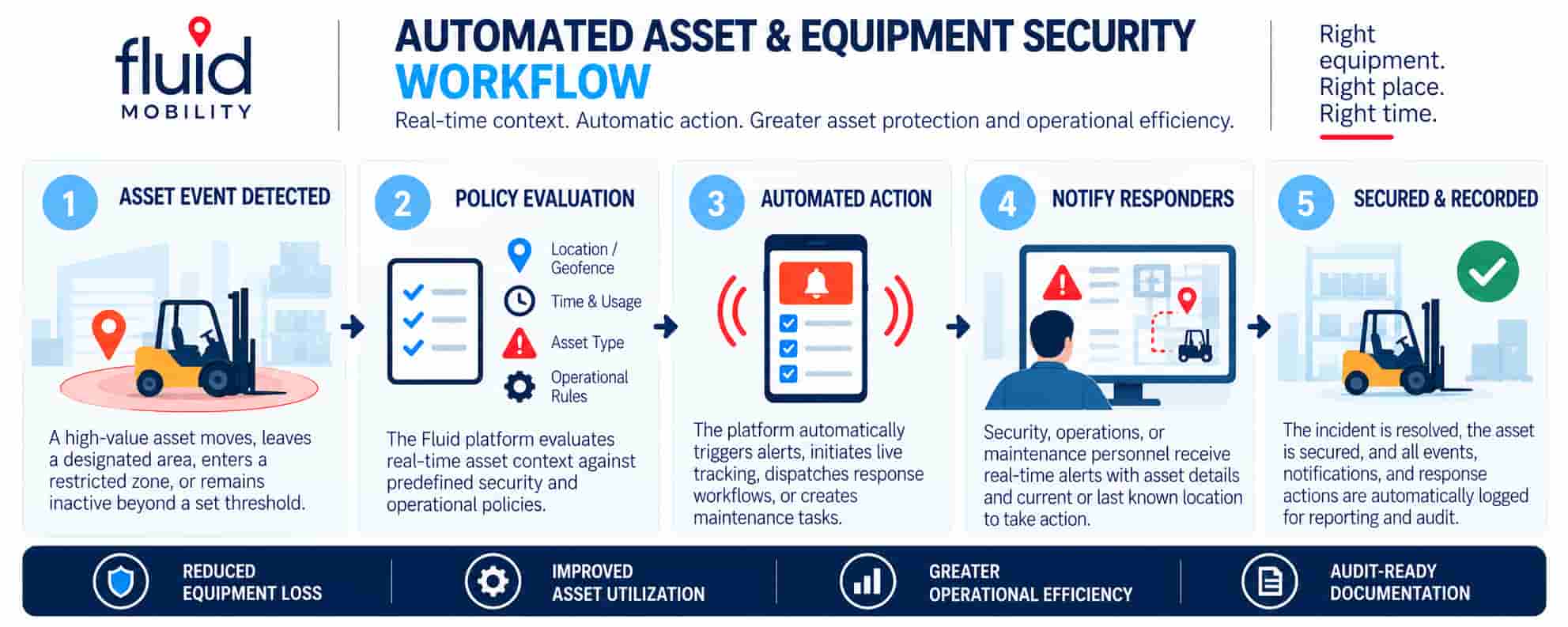
When predefined conditions are detected, FLUID can automatically dispatch security alerts, initiate asset recovery procedures, trigger maintenance and inspection workflows, and record asset activity. This helps organizations reduce equipment loss, minimize downtime, improve resource allocation, and strengthen operational efficiency.
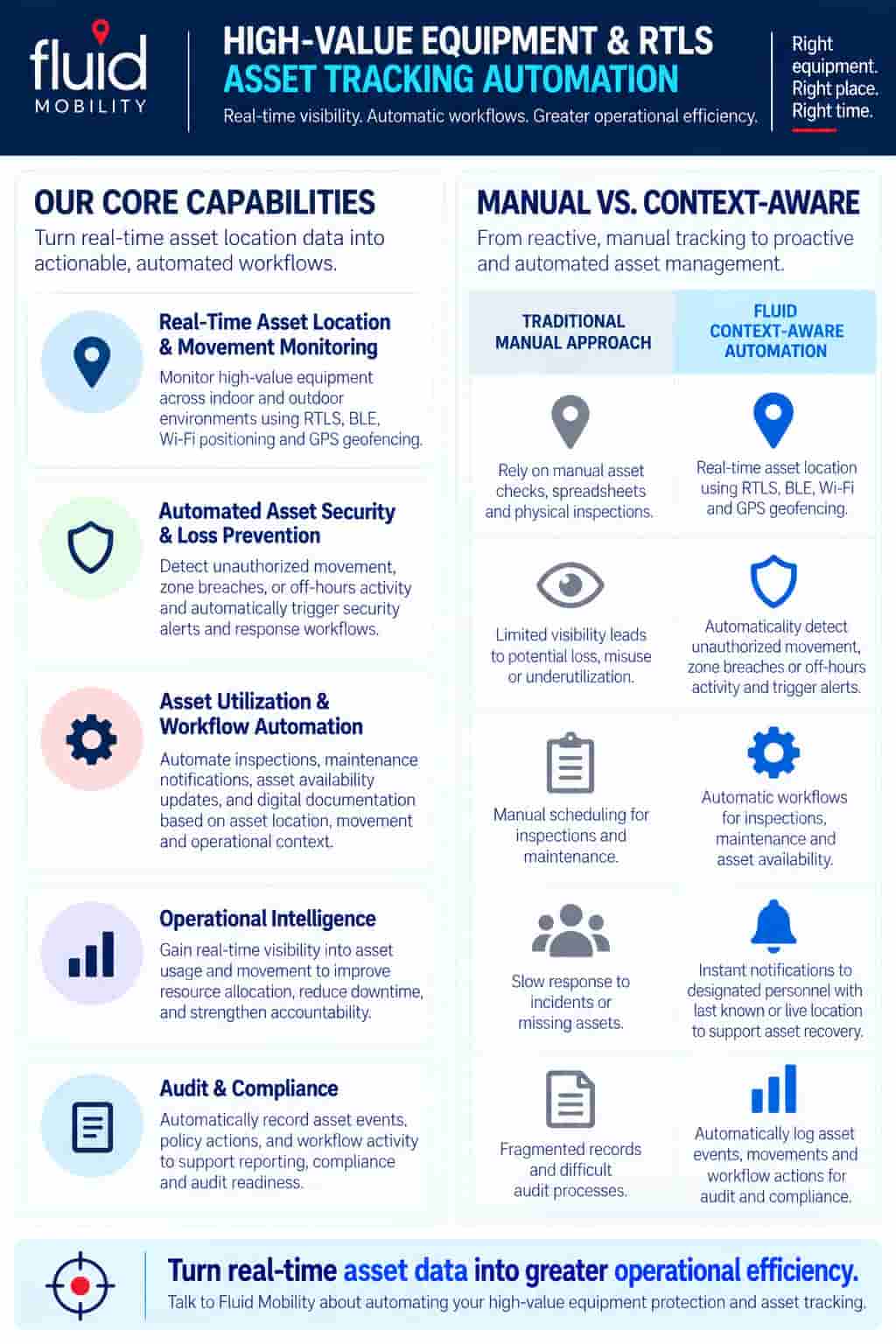
Real-Time Asset Location and Movement Monitoring
Monitor high-value equipment across indoor facilities and outdoor environments using BLE-enabled RTLS, Wi-Fi positioning, and GPS geofencing. Detect when assets enter or exit designated areas, move unexpectedly, or remain unused beyond predefined thresholds.
.
Automated Asset Security and Loss Prevention
Automatically initiate security alerts and response workflows when critical equipment leaves an authorized location, crosses a geofence boundary, or moves outside approved operating hours. Notify designated personnel and provide available location intelligence to support asset recovery.
Asset Utilization & Digital Workflow Automation
Use location, movement, time, and operational context triggers to automate equipment inspections, maintenance notifications, asset availability updates, and digital documentation. Improve equipment visibility, reduce manual tracking, and support more efficient asset allocation.
How Fluid Mobility Automates High-Value Equipment Protection & Asset Tracking
When a high-value asset enters or exits a designated zone, moves unexpectedly, or remains inactive beyond a predefined threshold, Fluid Mobility's context-aware engine detects the event using indoor RTLS, BLE, Wi-Fi positioning, or outdoor GPS geofencing.
The FLUID platform evaluates contextual data - including asset location, movement, time, authorized operating areas, and operational status - to automatically initiate the appropriate security or asset management workflow.
• Prevents equipment loss and unauthorized movement by detecting asset movements across defined boundaries and automatically notifying security or operations personnel.
• Improves asset utilization and operational efficiency by providing real-time equipment visibility and triggering workflows based on asset availability, location, and activity.
• Reduces administrative costs and strengthens accountability by automating inspections, maintenance notifications, asset movement records, and digital audit documentation.
Context Triggers & Automated Actions
|
Context Signal / Technology |
Trigger Condition |
Automated Action |
Asset Security & Operational Outcome |
|
Indoor RTLS / BLE Beacons |
High-value equipment exits its assigned room, department, or storage zone. |
Sends an automated movement alert and provides available asset location information. |
Asset Protection: Helps prevent unauthorized movement and equipment loss. |
|
GPS / Geofence Boundary |
Vehicle, machinery, or mobile equipment crosses an authorized site perimeter. |
Notifies designated personnel and initiates an asset security or recovery workflow. |
Theft & Loss Prevention: Supports faster identification of unauthorized asset movement. |
|
Time & Movement Context |
Equipment moves outside approved operating hours. |
Triggers a security notification and logs the movement event. |
Unauthorized Use Detection: Improves oversight of high-value equipment. |
|
RTLS / Asset Inactivity |
Equipment remains unused beyond a predefined utilization threshold. |
Notifies asset managers or initiates an equipment reassignment workflow. |
Improved Asset Utilization: Helps identify underused equipment and reduce unnecessary purchases. |
|
Location & Maintenance Schedule |
Equipment enters a maintenance area or reaches a scheduled inspection milestone. |
Dispatches a digital inspection checklist or maintenance task. |
Reduced Downtime: Supports preventive maintenance and consistent equipment servicing. |
|
Asset Proximity / Zone Entry |
Equipment enters an incompatible, hazardous, or restricted operating area. |
Issues a location-based alert or initiates an inspection workflow. |
Equipment & Site Safety: Helps reduce inappropriate equipment placement and operational risks. |
|
Location & Task Context |
Equipment arrives at a designated work area or operational checkpoint. |
Initiates a task notification, asset status update, or digital handover workflow. |
Workflow Efficiency: Reduces manual coordination and administrative effort. |
|
Asset Movement / Event Logging |
Equipment changes location, crosses a boundary, or triggers an automated workflow. |
Records relevant timestamps, location events, notifications, and workflow activity. |
Audit Readiness: Improves traceability, accountability, and asset management documentation. |
Frequently Asked Questions
What is RTLS asset tracking, and how does it work?
Real-Time Location Systems (RTLS) use technologies such as Bluetooth Low Energy (BLE), Wi-Fi, and other positioning infrastructure to identify and monitor the location of physical assets.
Fluid Mobility combines RTLS with context-aware automation to track high-value equipment, detect location changes, and automatically initiate security alerts, inspections, and operational workflows.
Fluid Mobility's FLUID platform combines GPS geofencing, indoor Real-Time Location Systems (RTLS), Bluetooth Low Energy (BLE), and context-aware automation to trigger emergency alerts, worker safety checklists, incident escalation procedures, and digital documentation. This helps organizations improve workplace safety, reduce response delays, and strengthen operational accountability.
How does Fluid Mobility protect high-value equipment from theft or unauthorized movement?
Fluid Mobility helps protect high-value equipment by monitoring asset location and detecting movement outside authorized areas, operating hours, or designated geofences.
When a predefined condition is met, FLUID can automatically notify security personnel, provide available asset location information, and initiate a recovery or investigation workflow.
How can RTLS and geofencing improve asset utilization?
RTLS and geofencing improve asset utilization by helping organizations identify where equipment is located, how frequently it moves, and when it may be available or underused.
Fluid Mobility uses this contextual information to support equipment allocation, reduce search times, and initiate reassignment or operational workflows based on predefined conditions.
What is the difference between indoor RTLS and GPS asset tracking?
Indoor RTLS uses technologies such as BLE and Wi-Fi to locate equipment inside buildings, warehouses, hospitals, and industrial facilities. GPS asset tracking uses satellite-based positioning to monitor equipment across outdoor sites and geographic areas.
Fluid Mobility can combine both technologies to support asset visibility and location-triggered workflows across indoor and outdoor environments.
Can Fluid Mobility automatically detect when equipment leaves an authorized area?
Yes. When supported by the deployed tracking infrastructure, Fluid Mobility can detect when equipment crosses a defined geofence or RTLS zone boundary.
FLUID can then trigger automated notifications, log the movement event, and initiate predefined security or asset recovery procedures.
How does context-aware automation reduce equipment loss and operational costs?
Context-aware automation helps reduce equipment loss and operational costs by detecting unauthorized movement, reducing time spent locating assets, and minimizing manual equipment management activities.
Fluid Mobility can also help identify underutilized assets and initiate inspection, maintenance, or reassignment workflows to support more efficient equipment use.
Can RTLS asset tracking automate equipment inspections and maintenance workflows?
Yes. RTLS asset tracking can support automated equipment inspections and maintenance workflows when integrated with compatible task management or maintenance systems.
Fluid Mobility can use location, time, movement, and operational triggers to dispatch digital inspection checklists, notify maintenance personnel, and record workflow activity.
Can Fluid Mobility detect worker inactivity, falls, or man-down incidents?
Fluid Mobility can support automated inactivity and man-down detection when integrated with compatible mobile devices, wearable sensors, or RTLS technologies capable of detecting the relevant conditions.
For example, prolonged inactivity or a fall-detection alert can initiate a worker check-in, followed by an emergency escalation if the worker does not respond. The FLUID platform can then notify designated personnel and provide available location information to support incident response.
Important distinction: Inactivity alone does not confirm an injury, and fall detection requires suitable sensor capabilities. Detection thresholds and escalation procedures should be configured to minimize false alarms.
How does Fluid Mobility support asset tracking audit documentation?
Fluid Mobility supports asset tracking audit documentation by recording configured location events, geofence crossings, automated alerts, timestamps, and workflow activity.
These digital records help organizations investigate equipment movements, improve accountability, and maintain documentation for operational reviews and asset management audits.
Can Fluid Mobility track equipment across multiple facilities and outdoor sites?
Yes. Fluid Mobility can support asset tracking across multiple indoor facilities and outdoor locations using compatible RTLS infrastructure, BLE-enabled devices, and GPS-based positioning technologies.
Organizations can configure location-specific triggers and automated workflows to reflect different sites, equipment types, and operational requirements.
How does Fluid Mobility support digital incident reporting and safety audit documentation?
Fluid Mobility supports digital incident reporting and safety audit documentation by connecting context-triggered events with automated workflows, reporting systems, and electronic records.
Depending on system configuration, FLUID can capture timestamps, location events, workflow initiation, user acknowledgments, incident escalations, and task completion information. These records help organizations improve accountability, investigate incidents, document corrective actions, and prepare for workplace safety audits.
Digital incident management and inspection systems commonly connect reporting, investigations, corrective actions, and audit records to improve safety oversight.
What types of equipment can be monitored using RTLS and geofencing?
RTLS and geofencing can monitor many categories of high-value equipment when suitable tracking devices or location-enabled endpoints are available.
Common examples include medical equipment, manufacturing tools, industrial machinery, IT assets, warehouse equipment, vehicles, and mobile field equipment.
Which industries benefit from automated RTLS asset tracking?
Industries with expensive, mobile, shared, or operationally critical equipment can benefit from RTLS asset tracking and context-aware automation.
Examples include healthcare, manufacturing, construction, energy and utilities, transportation, logistics, government, and critical infrastructure.
How does Fluid Mobility integrate asset tracking with existing operational systems?
Fluid Mobility's context-aware platform can use RTLS and geofencing events to initiate workflows through supported integrations with enterprise operational systems.
Depending on the integration, these workflows may include maintenance requests, security notifications, inspection assignments, equipment status updates, and digital records.
Our Recent Insights
Explore how context-aware security and mobile policy automation are reshaping high-security environments across critical industries.
10/13/2026
Automated RTLS Asset Tracking for High-Value Equipment
Automated RTLS Asset Tracking for High-Value Equipment
10/13/2026
Automated Incident Response for Field & Lone Workers
Automated incident response uses real-time location, geofencing, connected devices,and predefined...
09/16/2026
Enhancing Security, Safety, and Efficiency with Context-Aware Automation
Every day, things change. A worker starts a shift. A device enters a secure facility. Someone...
09/09/2026
What Is Context-Aware Security? And Why Does Context Matter?
Security knows who you are. But does it know what's happening around you? Security has...