Automated Safety & Security Workflows
How Does Fluid Mobility Automate Asset Security and Protection?
Fluid Mobility automates asset security and protection by combining context signals from BLE devices, mobile, devices, geofences, and visual data to automatically trigger safety & security workflows.
The FLUID platform continuously monitors asset location, movement, and operational context across indoor and outdoor environments.
When predefined conditions are detected - such as equipment leaving an authorized area, crossing a geofence, or moving outside approved operating hours - FLUID automatically initiates security alerts, notifies designated personnel, and triggers asset recovery workflows.
Three key benefits of automated asset security and protection include:
- Prevent Equipment Theft & Loss: Detect unauthorized asset movement, geofence violations, and unexpected equipment relocation to automatically initiate security alerts and recovery procedures.
- Improve Asset Visibility & Utilization: Track equipment location and movement in real time, reduce asset search times, identify underutilized equipment, and optimize resource allocation.
- Automate Asset Security Workflows & Audit Documentation: Trigger equipment inspections, security notifications, and incident response procedures while maintaining digital records of asset movements, timestamps, and automated actions.
By transforming real-time asset location data into automated security and operational workflows, Fluid Mobility helps organizations protect high-value equipment, reduce asset losses, improve operational efficiency, and lower asset management costs.
Protect Your Assets, People, and Data. Make Your Security FLUID.
Turn real-time asset intelligence into automated protection with Fluid Mobility. Automate safety and security workflows with context-aware automation tailored to your operations.
Contact us today to discuss your asset security challenges, explore FLUID's capabilities, or schedule a personalized demo.
Restricted and High-Security Zone Protocol Automation
Automatically enforce device lockdowns, camera restrictions, and data access controls the moment a device enters a restricted zone — triggered by geofencing, BLE, or indoor RTLS.
Automated Incident Response & Field Safety Protocols
Automate lone worker check-ins, panic alerts, and emergency escalation workflows based on real-time location, inactivity, and SOS signals — no manual intervention required.
High Value Equipment and RTLS Asset Tracking Automation
Monitor high-value equipment across indoor and outdoor environments using BLE, Wi-Fi, and GPS geofencing — and automatically trigger security alerts when assets move outside authorized zones.
How Does Fluid Mobility Turn Real-Time Context into Automated Action?
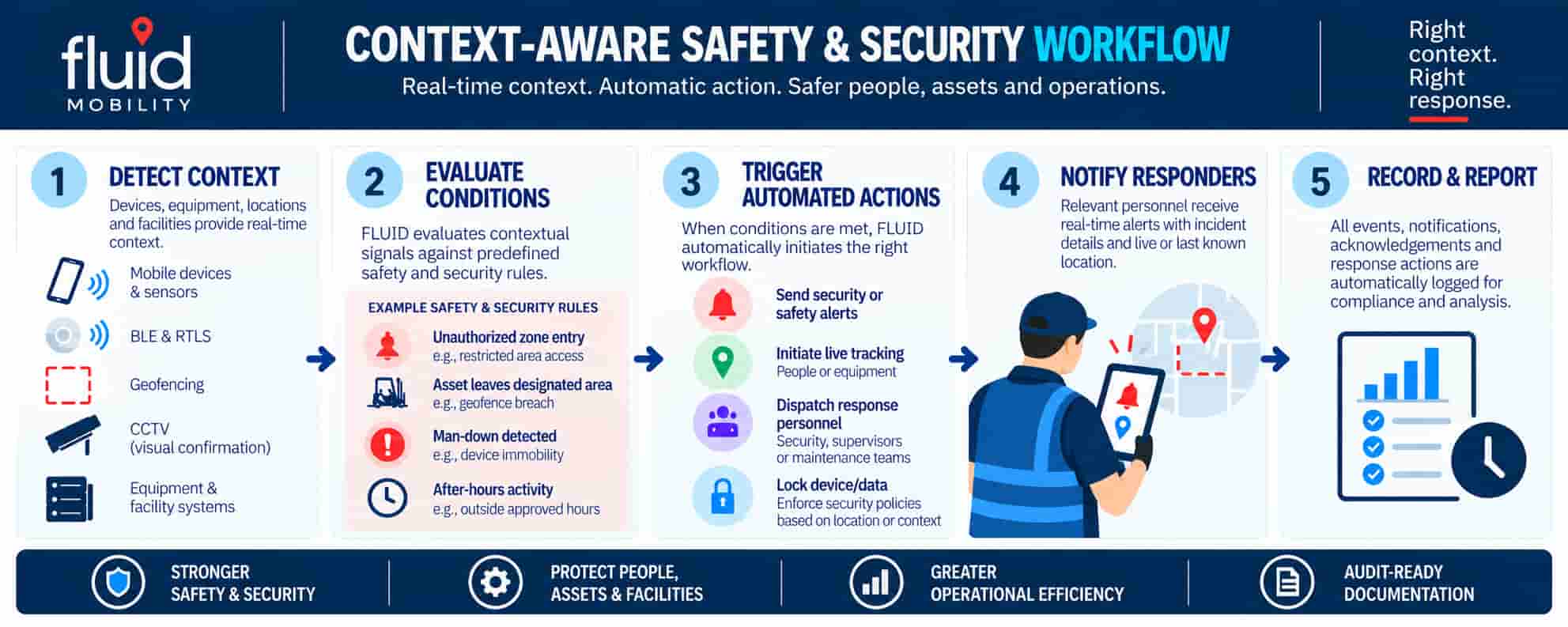
Fluid Mobility automates safety and security workflows by combining real-time contextual signals from mobile devices, BLE, RTLS, geofencing, CCTV, and connected equipment.
The FLUID platform continuously evaluates these signals against predefined safety, security, and operational rules. When specific conditions are detected, FLUID automatically initiates the appropriate workflow—helping organizations protect people, secure high-value assets, and enforce security
policies.
How Context-Aware Automation Works: The Fluid Mobility Five-Step Process
|
Step |
Description |
Use Cases & Business Benefits |
|---|---|---|
|
1. Detect Context |
FLUID collects contextual information from mobile devices, sensors, BLE, RTLS, geofencing, CCTV, and connected facility systems. |
Real-Time Location Monitoring: Identify the location and movement of workers, equipment, and mobile devices to improve operational visibility. |
|
2. Evaluate Conditions |
The platform evaluates real-time signals against predefined rules, identifying events such as unauthorized zone entry, unexpected equipment movement, potential worker safety incidents, or after-hours activity. |
Automated Risk Detection: Identify geofence violations, unauthorized asset movement, and potential worker safety incidents without continuous manual monitoring. |
|
3. Trigger Automated Actions |
When configured conditions are met, FLUID automatically initiates the appropriate response, including security alerts, worker safety workflows, asset tracking, or supported mobile device and data security controls. |
Automated Safety & Security Workflows: Initiate incident alerts, asset protection procedures, and location-based mobile security policies. |
|
4. Notify Responders |
Designated personnel receive alerts with relevant incident details and available real-time or last-known location information, enabling faster, more coordinated responses. |
Incident Response Coordination: Notify security teams, supervisors, or emergency responders with actionable incident information. |
|
5. Record & Report |
FLUID records relevant events, notifications, acknowledgements, and response actions to support operational analysis, incident reviews, and audit documentation. |
Audit-Ready Documentation: Maintain digital records of security incidents, automated actions, and response activities to support reporting and internal audits. |
What is context-aware safety and security automation?
Context-aware safety and security automation uses real-time information from location systems, mobile devices, sensors, and connected infrastructure to automatically initiate predefined safety and security workflows. Fluid Mobility's FLUID platform evaluates contextual signals such as location, movement, time, and device status to trigger security alerts, worker safety procedures, and mobile device security policies.
How does Fluid Mobility's FLUID platform work?
Fluid Mobility's FLUID platform collects contextual signals from technologies such as RTLS, Bluetooth Low Energy (BLE), GPS, geofencing, and mobile devices. It evaluates these signals against predefined organizational rules and automatically initiates appropriate actions, including incident notifications, asset security alerts, safety check-ins, and supported mobile device security controls.
How does Fluid Mobility use RTLS, BLE, GPS, and geofencing to automate security workflows?
Fluid Mobility combines indoor Real-Time Location Systems (RTLS), BLE proximity detection, GPS positioning, and geofencing to identify location-based events. When equipment, workers, or managed devices enter or exit designated areas, FLUID evaluates the event against predefined rules and can automatically initiate security notifications, safety procedures, or device policy changes.
What types of safety and security workflows can Fluid Mobility automate?
Fluid Mobility can automate a range of configurable safety and security workflows, including:
- Unauthorized equipment movement alerts and asset security procedures.
- Worker safety check-ins, BLE duress notifications, and incident escalation.
- Location-based mobile device and data security policies.
- Restricted-zone entry notifications and security responses.
- Equipment inspections, maintenance notifications, and event documentation.
How does context-aware automation differ from traditional security monitoring?
Traditional security monitoring primarily identifies and reports events, often requiring personnel to interpret information and initiate a response. Context-aware automation evaluates multiple signals against predefined rules and initiates appropriate actions automatically. This reduces reliance on continuous manual monitoring and helps organizations respond consistently to safety and security events.
How can RTLS and geofencing help prevent unauthorized equipment movement and asset loss?
RTLS and geofencing help organizations detect when tracked equipment leaves authorized areas, enters restricted zones, or moves outside approved operating hours. Fluid Mobility can automatically notify security personnel, provide available asset location information, and initiate predefined response workflows. These capabilities support earlier intervention and may reduce equipment loss and theft.
Can Fluid Mobility automatically detect and respond to worker safety incidents?
Yes. Fluid Mobility can identify configured indicators of potential worker safety incidents, such as prolonged inactivity, missed safety check-ins, hazardous-zone entry, or activation of a BLE duress button. FLUID can then initiate notifications, request worker confirmation, or escalate the event to designated response personnel. Detection capabilities depend on the available sensors and configured rules.
How does Fluid Mobility improve lone-worker safety in hazardous or remote environments?
Fluid Mobility improves lone-worker safety by using GPS, geofencing, BLE, and supported location technologies to initiate automated check-ins, hazardous-area notifications, and emergency escalation workflows. When a worker misses a scheduled check-in or activates a duress alert, FLUID can notify supervisors and provide available location information to support incident response.
Can Fluid Mobility automatically trigger emergency alerts and notify response personnel?
Yes. Fluid Mobility can automatically initiate emergency notifications when predefined safety or security conditions are detected. Alerts can include incident details, available real-time or last-known location information, and relevant contextual data. Configured escalation workflows help supervisors, security teams, and designated responders coordinate their response without relying exclusively on manual incident reporting.
How does Fluid Mobility automate mobile device and data security in restricted zones?
Fluid Mobility uses location-based context, geofencing, and supported Mobile Device Management (MDM) or Unified Endpoint Management (UEM) integrations to automate security policies in restricted areas. When a managed device enters a designated high-security zone, FLUID can initiate configured restrictions on supported device features, applications, or corporate data access.
an Fluid Mobility automate safety and security workflows across indoor and outdoor environments?
Yes. Fluid Mobility can support indoor and outdoor context-aware automation by combining compatible technologies such as indoor RTLS, BLE, Wi-Fi positioning, and outdoor GPS geofencing. Organizations can configure location-based workflows across facilities, equipment yards, industrial sites, and field environments, subject to the coverage and capabilities of their deployed tracking infrastructure.
How does Fluid Mobility support incident reporting, audit documentation, and compliance processes?
Fluid Mobility can automatically document relevant contextual events, security alerts, workflow actions, notifications, and response acknowledgements. These digital records support incident investigations, operational reporting, internal audits, and reviews of safety and security procedures. Automated documentation can reduce administrative effort, although regulatory compliance also depends on an organization's broader controls and processes.
What industries benefit most from context-aware safety and security automation?
Context-aware safety and security automation benefits organizations managing valuable equipment, hazardous work environments, or restricted facilities. Relevant industries include manufacturing, healthcare, energy and utilities, construction, transportation and logistics, government, and critical infrastructure. Fluid Mobility helps these organizations automate asset protection, worker safety procedures, and location-based security controls.
Automate Your Safety & Security Workflows with Fluid Mobility
Automate security workflows, protect high-value equipment, and keep your field teams safer — all from one platform. See how Fluid Mobility's FLUID platform works for your operations.

