
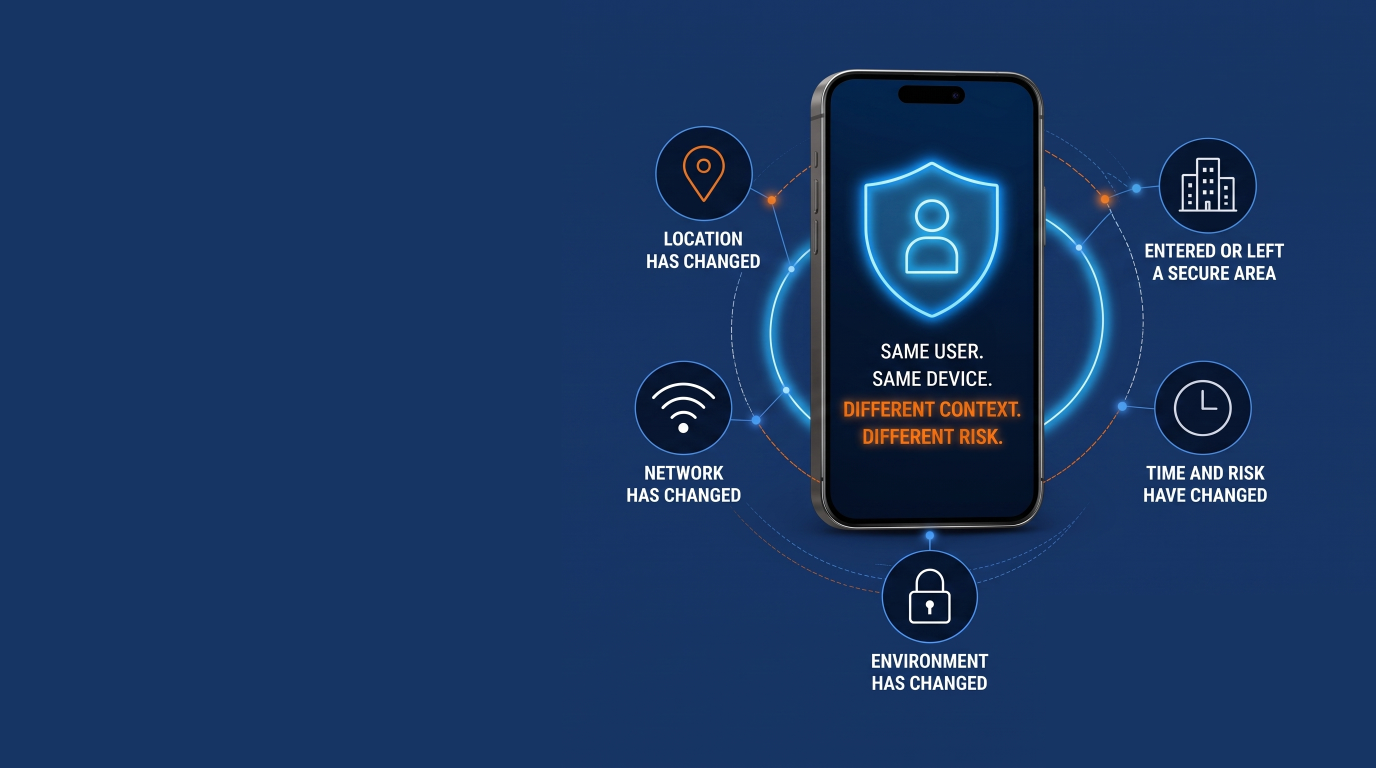
Security knows who you are. But does it know what's happening around you?
Security has traditionally been very good at asking questions like:
- Who are you?
- What device are you using?
- What are you trying to access?
Those questions are important. But they're not always the whole story.
Imagine an authorised employee using an approved device to access an approved application. Nothing about their identity has changed. Nothing about the device has changed. But in the last five minutes, they may have:
- Left a secure facility
- Connected to a different network
- Moved into a public environment
- Started travelling
- Begun or ended a shift
The user is the same. The device is the same. But the context isn't. And sometimes, that context should matter to the security decision.
This is the idea behind context-aware security.
What Is Context-Aware Security?
Context-aware security is an approach to cybersecurity that considers the circumstances surrounding a user, device, or activity when making security decisions.
Traditional security decisions often rely heavily on factors such as identity, authentication, device status, and access permissions. Context-aware security adds another layer to that decision-making process:
What's happening around the user and device right now?
That context can include information such as:
- Location
- Network
- Time
- Speed or movement
- Shift or work status
- Whether a device has entered or left a defined area
- The surrounding operational environment
The goal isn't necessarily to treat every change as a threat.
It's to recognize that the same user and device can represent different levels of risk in different circumstances.
Why Is Context Important in Cybersecurity?
Security policies are often designed to answer a straightforward question: Is this user allowed to do this?
Context introduces another question: Should they be allowed to do it under these circumstances?
Consider two situations. In both cases:
- The employee is authorized
- The device is managed
- The application is approved
But in one situation, the employee is working inside a secure facility.
In the other, they are accessing the same information from a public environment.
Identity hasn't changed. The application hasn't changed. But the circumstances have.
Context-aware security recognizes that those circumstances may matter.
This doesn't mean every change in location or network should automatically result in blocked access.
Instead, context can provide additional information that helps organizations make more informed and proportionate security decisions.
The Same Device Can Have Different Context
Mobile technology has made this challenge increasingly relevant.
Devices are no longer confined to a single office, network, or operating environment.
They move. People move. Work moves.
And operational conditions can change throughout the day.
A device may move from: Office → vehicle → customer site → public location → home
All while remaining connected to the same applications and systems.
From a traditional security perspective, the identity of the user may remain constant.
But from an operational perspective, a lot has changed.
This is where context becomes valuable.
Security doesn't always need more information about who someone is. Sometimes it needs more information about what's happening around them.
What Information Can Provide Security Context?
Context can come from many different sources.
The most useful information depends on the organization, its environment, and the type of work being performed.
Location
Location can help establish where a device is operating. For example, an organization may want to distinguish between:
- A secure office
- A restricted facility
- A customer location
- A remote work environment
- A public space
Location intelligence can provide an additional layer of context when determining how policies should apply.
Network
A device's network environment can also provide important context.
For example, connecting through a known corporate network may present a different security situation than connecting through an unfamiliar public network.
Again, the user may be exactly the same.
The environment isn't.
Time
Time can add context to security and operational decisions.
Is someone accessing a system during their normal working hours? Outside of an expected shift? At an unusual time for that particular activity?
Time alone doesn't necessarily indicate risk.
But combined with other contextual information, it can help create a more complete picture.
Speed and Movement
Movement can also provide useful context.
Is a device stationary? Moving between locations? Travelling at a speed that suggests the user is in a vehicle?
Movement intelligence may be particularly relevant in industries where employees and devices are highly mobile.
The important point is that security decisions don't always need to be based on a single signal.
Context becomes more useful when different signals are considered together.
Shift and Operational Intelligence
In many organizations, the operational context around a user can matter just as much as their technical identity.
For example:
- Is the employee currently on shift?
- Are they performing an expected task?
- Are they working within an authorized operational environment?
- Has their role or situation changed?
Combining security and operational context can help organizations move beyond static policies and toward more responsive decision-making.
What Is Adaptive Security?
Adaptive security is an approach in which security controls or decisions can respond to changing conditions and levels of risk.
Rather than applying exactly the same policy in every situation, adaptive security allows organizations to consider whether changing circumstances should trigger a different response.
That response could include:
- Applying additional controls
- Restricting access to specific information
- Requiring additional authentication
- Changing application behaviour
- Triggering a workflow or notification
- Applying a different policy based on the surrounding context
The key word is adaptive.
The security approach can respond when the situation changes.
This is particularly relevant in mobile environments, where users and devices can move through multiple locations, networks, and operating conditions in a single day.
Context-Aware Security Isn't About Adding More Friction
One concern organizations may have is that more security context means more security interruptions.
But that doesn't necessarily have to be the outcome.
In fact, context-aware automation can potentially help organizations apply controls more selectively.
Instead of applying the same restrictions to every user, everywhere, all the time, organizations can define situations where additional controls are appropriate.
That means the security response can be better aligned with the circumstances.
The objective isn't: More security at every moment.
It's: The right security for the context.
That distinction matters.
Because effective security needs to protect the organization without unnecessarily making it harder for people to do their jobs.
How Can Location and Context Intelligence Support Cybersecurity?
This is where location intelligence becomes particularly interesting.
Location has traditionally been viewed as useful primarily for navigation, tracking, or operations.
But location can also provide security context.
For example, location intelligence can help an organization understand when a device:
- Enters or leaves a defined area
- Moves between approved and unapproved environments
- Changes operational context
- Moves while accessing sensitive applications
- Requires a different security policy based on where it is operating
When combined with other signals including network, time, speed, role, and shift information - location can become part of a broader context-aware security strategy.
At Fluid Mobility, this is a core part of how we think about mobile security.
Location isn't just a dot on a map.
It's context.
And context can help organizations make more intelligent decisions about how security policies should respond to the real world.
The Future of Security May Be More Contextual
Identity will remain a critical part of cybersecurity.
So will authentication. Device management. Access controls. Network security.
None of those are going away.
But as work and operations become increasingly mobile, static security policies may not always reflect the reality of how people and devices operate.
The same employee can work in multiple environments.
The same device can connect through multiple networks.
The same application can be accessed under very different circumstances.
Identity tells you who someone is.
Context helps you understand what's happening around them.
And sometimes, that difference matters.
Because the next generation of security decisions may not simply ask:
Who are you?
They may also ask:
What's happening around you?
Frequently Asked Questions
What is context-aware security?
Context-aware security is a cybersecurity approach that considers information about the circumstances surrounding a user, device, or activity when making security decisions. Context can include factors such as location, network, time, movement, and operational status.
Why is context important in cybersecurity?
Context provides additional information beyond identity and access permissions. A user may be authorised and using an approved device, but changes in location, network, time, or environment can affect the circumstances surrounding a security decision.
What is the difference between identity-based security and context-aware security?
Identity-based security focuses primarily on who a user is and what they are authorised to access. Context-aware security adds information about the circumstances surrounding the user, device, or activity to provide a broader basis for security decisions.
What information can be used as security context?
Security context can include location, network, time, device status, movement or speed, role, shift information, and environmental or operational conditions.
What is adaptive security?
Adaptive security is an approach in which security controls can respond to changing circumstances or levels of risk rather than applying exactly the same policy in every situation.
How can location intelligence support cybersecurity?
Location intelligence can provide information about where a device is operating and whether it has entered, left, or moved between defined environments. When combined with other contextual information, it can help organisations make more informed security decisions.