
How Does Fluid Mobility Automate Visitor Management and Tracking?
Automated Visitor Tracking, Restricted-Area Monitoring, and Context-Aware Security Workflows
Fluid Mobility automates visitor management by combining Real-Time Location Systems (RTLS), Bluetooth Low Energy (BLE), geofencing, and context-aware automation to monitor visitor movement and trigger security workflows. The FLUID platform helps organizations detect unauthorized zone entry, notify security personnel, improve visitor accountability, and reduce manual monitoring across facilities and worksites.
What Common Challenges does Visitor Management Address?
Organizations must manage visitor access, monitor movement, and maintain accurate records of who is on-site. Traditional visitor management systems typically focus on registration, identification, and check-in procedures, providing limited visibility into visitor activity after entry.
This creates operational and security challenges for facilities with restricted areas, complex visitor permissions, and high volumes of contractors or guests.
Four common visitor management problems include:
How Does Fluid Mobility Automate Visitor Management?
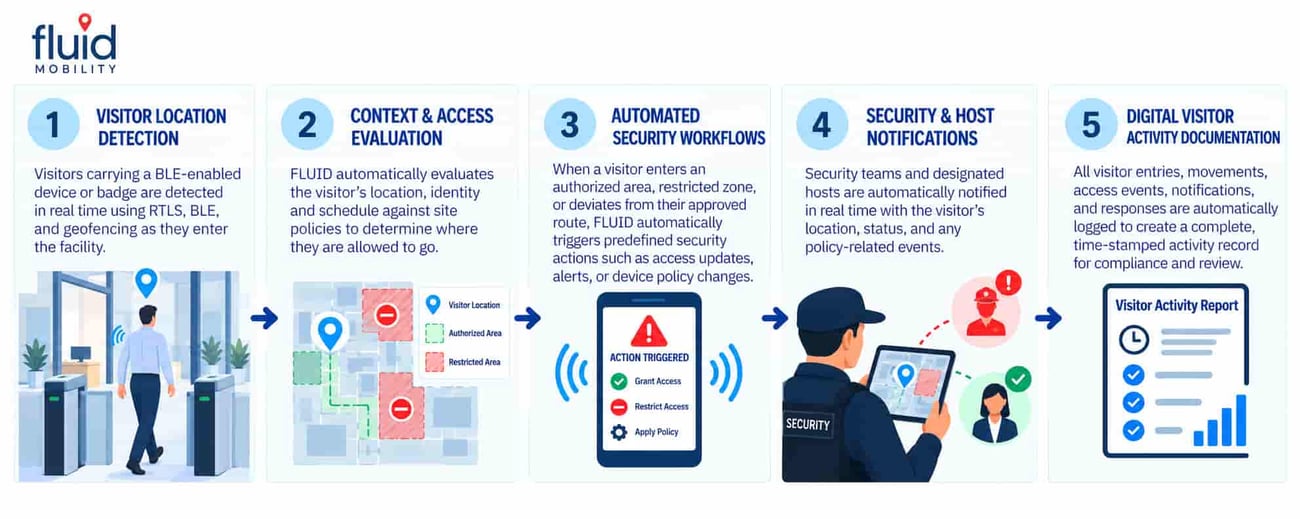
Fluid Mobility automates visitor management by detecting visitor location and movement, evaluating contextual information against predefined security rules, and initiating automated visitor management workflows.
The FLUID platform uses indoor RTLS, BLE-enabled visitor badges, mobile devices, and outdoor GPS geofencing to monitor visitor activity and trigger location-based notifications, security alerts, and operational workflows.
The FLUID Five-Step Visitor Management Workflow:
Organizations managing visitors across their premises must maintain visibility into who is on-site, where visitors are located, and whether they have entered authorized or restricted areas. Traditional visitor management procedures often rely on manual sign-in logs, paper visitor records, physical identification badges, and fragmented access control systems, limiting real-time visibility into visitor movements and making it difficult to identify and respond to potential safety or security concerns.
Five-Step Visitor Management Workflow
|
Step |
Technical Process |
Visitor Management Example |
|
1. Detect Context |
Collect visitor location, movement, proximity, and time-based signals from RTLS, BLE badges, GPS geofences, mobile devices, or connected systems. |
A visitor wearing a BLE-enabled badge approaches a restricted research laboratory. |
|
2. Evaluate Conditions |
Compare real-time visitor context against predefined security rules, authorized zones, visit schedules, and available access permissions. |
FLUID identifies that the visitor has entered an area outside their permitted access zone. |
|
3. Trigger Automated Actions |
Initiate configured security notifications, visitor alerts, escort requests, or incident response workflows. |
FLUID automatically triggers a restricted-area security alert. |
|
4. Notify Responders |
Send relevant event information and available visitor location data to designated security personnel or visitor hosts. |
Security personnel receive an alert identifying the restricted zone and visitor's detected location. |
|
5. Record & Report |
Document visitor location events, security alerts, notifications, acknowledgments, and response activities. |
The unauthorized entry event, timestamp, and security response are recorded for review. |
What are the Benefits of FLUID Visitor Management?
Automated visitor management improves facility security, visitor accountability, and operational efficiency by transforming real-time location and contextual data into automated security and operational workflows.
|
Feature |
Capability |
Business Benefit |
|---|---|---|
|
Real-Time Visitor Location & Movement Monitoring |
Monitor visitor movement across indoor and outdoor environments using RTLS, BLE-enabled identification badges, and GPS geofencing. |
Improve visitor visibility, identify unexpected movement, and help security personnel locate visitors when assistance is required. |
|
Automated Restricted-Area Detection & Security Alerts |
Detect when visitors enter unauthorized zones, cross restricted geofences, or remain in designated areas beyond permitted durations. |
Reduce reliance on manual monitoring, identify potential security violations, and accelerate security notifications. |
|
Context-Aware Visitor Permissions & Escort Workflows |
Evaluate visitor location, assigned host, authorized zones, and visit duration against predefined rules to trigger notifications and escort workflows. |
Improve consistency of visitor security procedures, reduce administrative coordination, and support appropriate visitor supervision. |
|
Digital Visitor Activity Documentation & Audit Trails |
Record configured visitor check-ins, location events, security notifications, response actions, and timestamps. |
Strengthen visitor accountability, support security investigations, and maintain digital documentation for facility security reviews. |
How Would Automated Visitor Management Work in a Secure Facility?
(1) Detect Context: A contractor checks into a manufacturing facility and receives a BLE-enabled visitor badge associated with their authorized visit.
(2) Evaluate Conditions: As the contractor moves throughout the facility, FLUID uses indoor RTLS infrastructure to monitor their detected location. When the contractor enters a restricted production area, the platform identifies a violation of the configured visitor access rules.
(3) Trigger Automated Actions: FLUIDautomatically initiates a restricted-area security workflow and generates an alert identifying the visitor's detected location.
(4) Notify Responders: Facility security personnel and the contractor's designated host receive a notification containing the event details. Security personnel can investigate, contact the visitor, or initiate an escort response.
(5) Record & Report: The platform records relevant location events, security notifications, timestamps, and response activities for subsequent review.
Outcome: Improved visitor accountability, faster detection of unauthorized movement, more consistent security procedures, and reduced dependence on manual visitor monitoring.