

Mobile Security Policies for Mobile Workforces
Mobile devices can become a significant data security and governance risk the moment an employee crosses a border or enters a new legal jurisdiction. Smartphones, tablets, and laptops may provide access to years of corporate communications, customer information, operational records, stored credentials, cloud platforms, and other sensitive resources.
Organizations today face a fragmented and constantly evolving landscape of privacy, cybersecurity, and data governance requirements, particularly across the European Union with its stringent GDPR requirements. As employees travel and work across jurisdictions, mobile devices can quickly become subject to different legal, regulatory, and organizational security obligations, making manual security management both difficult and error-prone. Across the United States, organizations face a fragmented governance landscape driven by state-specific privacy legislation, sector regulations, and agency-level security requirements. These varying obligations can require different mobile device and data security controls depending on where employees work or travel.
Border authorities in different countries operate under widely varying legal frameworks, with some empowered to inspect devices, retain them for further examination, request passwords, or compel access to encrypted information.
For example, New Zealand legislation authorizes certain searches of electronic-device data and defines access information to include passwords, codes, and encryption keys, while the United Kingdom’s Schedule 7 framework gives examining officers distinct powers to stop, question, search, and detain people and goods at ports and borders. In Hong Kong, the amended Implementation Rules for Article 43 of the National Security Law grants police the authority to require individuals to provide passwords, decryption keys, or other information needed to access electronic devices. In each case, additional security controls are essential for devices and data.
Recent developments also demonstrate that national-security priorities and digital-surveillance capabilities are expanding the practical reach of device inspections in several jurisdictions. Our recent survey found only 40% of organizations have device and data security configurations that adjust automatically based on jurisdictional requirements and threat levels. That leaves 6/10 of organizations exposed due to lack of processes in place and/or human error.
As a result, a device that is appropriately configured in one region may expose an organization to privacy violations, contractual breaches, regulatory reporting requirements, or compelled disclosure risks in another. Organizations must therefore treat international and interjurisdictional travel as a dynamic data-governance issue rather than assuming that one universal mobile security policy will remain effective everywhere.
The Hidden Blind Spot for Cross Border Travel: Dynamic Device and Data Security Automation
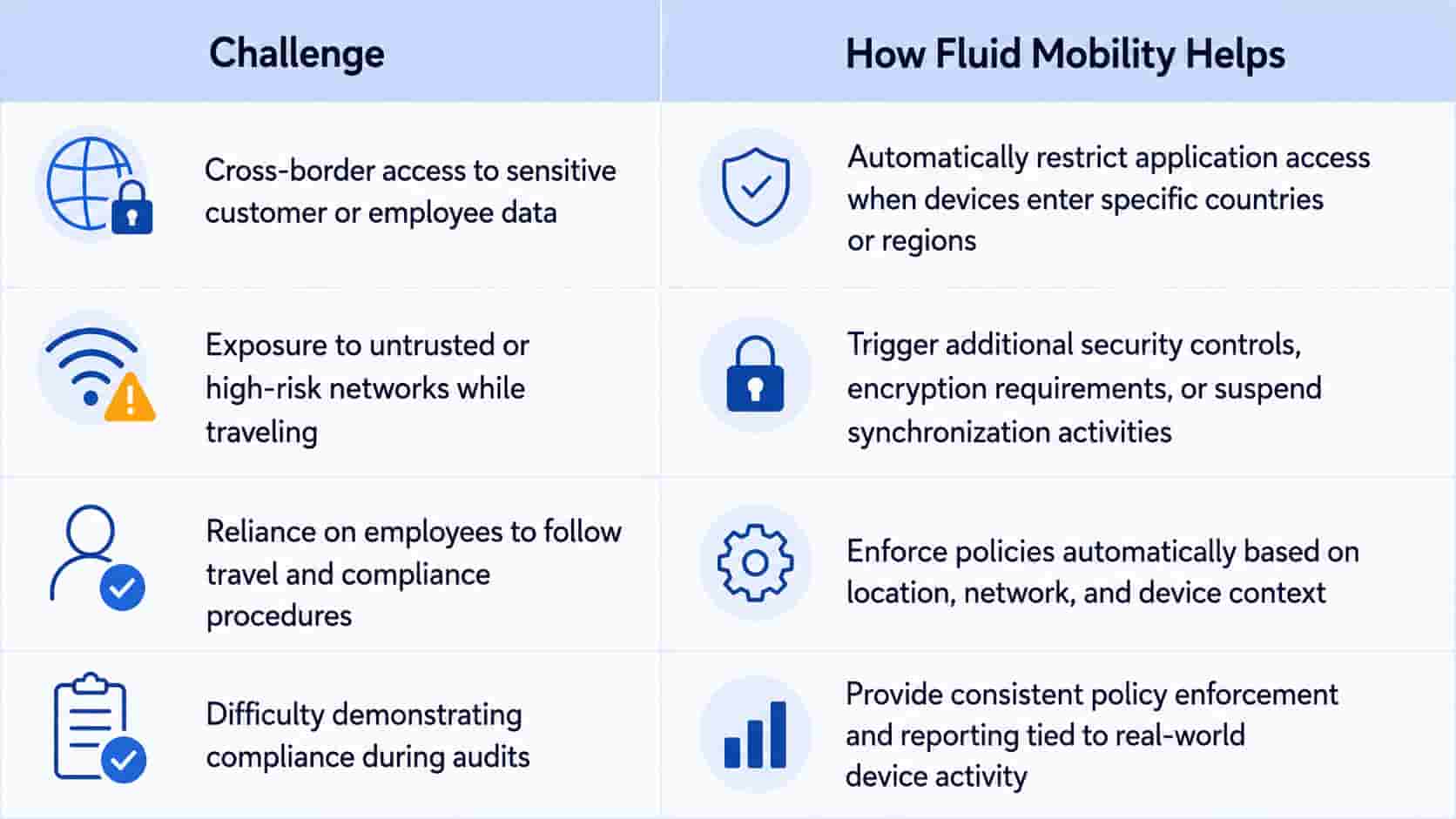
Organizations require dynamic mobile security policies because privacy laws, border-search powers, data-residency obligations, and disclosure requirements can change whenever a device enters a different country, province, state, airport, port, network, or regulated facility.
Static policies cannot reliably account for every employee’s location, role, travel route, network connection, or current legal environment. Manual processes are equally risky because they depend on employees remembering to activate the correct settings while navigating travel, operational responsibilities, inspections, and unfamiliar procedures. Routes and schedules can change unexpectedly, and even well-trained employees can become distracted or apply the wrong security profile, creating avoidable exposure windows and inconsistent compliance.
Fluid Mobility’s Context-Aware Security
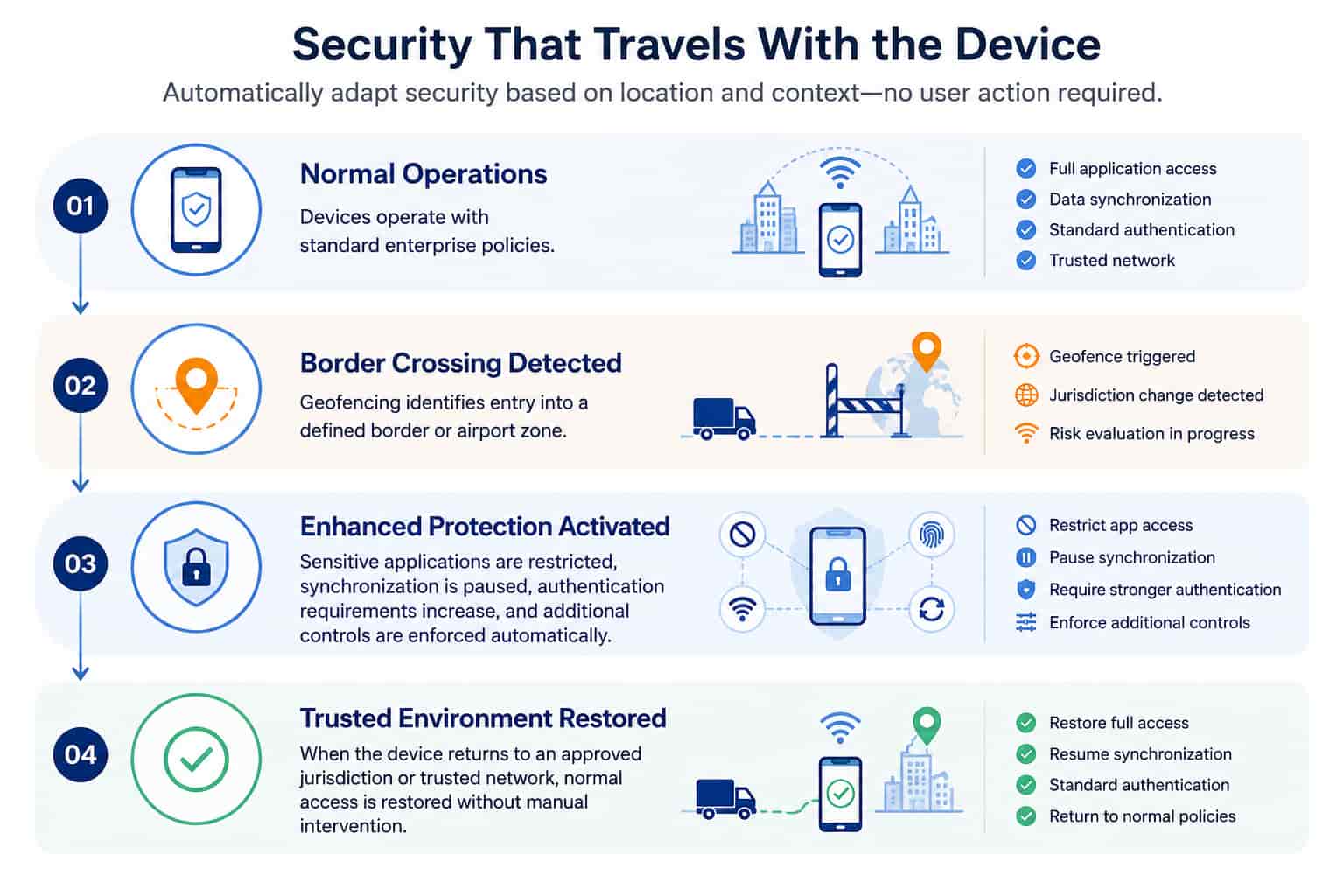
Fluid Mobility helps organizations establish context-aware device and data security processes that respond automatically to changes in location, time, network, user role, and operational conditions. Using geofences, location intelligence, network awareness, and MDM integration, Fluid can trigger predefined controls when a device approaches an airport, crosses a border, enters a sensitive jurisdiction, connects to an unfamiliar network, or moves into a mission-critical facility.
These controls can restrict access to sensitive applications and, critically, data; apply stronger authentication requirements, adjust app permissions, enforce secure work-container policies, deliver compliance instructions, alert security teams, and create an auditable record of when policies were applied. By automatically tying data and device availability to approved locations and operational contexts, Fluid reduces reliance on employees to recognize risk and manually change their device settings.
This allows organizations to apply jurisdiction-specific governance policies more consistently while helping mobile employees remain focused on their work.
A Fluid Security Strategy to Support Governance Requirements
Fluid Mobility's context-aware device and data security helps organizations support compliance and governance requirements such as GDPR by automatically applying security policies based on real-world context, such as a user's location, device status, network connection, time of day, or role.
Rather than relying on employees to manually enable or disable security settings, the platform can automatically restrict access to sensitive applications and data, require stronger authentication, enforce approved network connections, and apply geofence-based security controls when risk conditions change.
This supports the principle of data protection by design and by default by ensuring data is accessible only when appropriate and under predefined conditions. Context-aware policies also support GDPR's requirements for access control, accountability, and the protection of personal data by reducing unnecessary data exposure, creating auditable records of policy enforcement, and minimizing the risk of human error. By continuously adapting security controls to each operational context, Fluid Mobility helps organizations maintain more consistent governance while enabling employees to work securely across different locations and jurisdictions.
Evolve in Real-Time
Data security cannot remain static when employees, devices, and sensitive information move through jurisdictions with different laws and enforcement powers. Organizations need to understand what information is accessible through each device and apply controls before a border crossing or jurisdictional change creates an exposure window.
Fluid Mobility addresses this challenge by combining geofencing, contextual intelligence, mobile device management, and automated policy enforcement to adapt device behaviour and data access as risk conditions change. The result is stronger, more consistent governance with less manual effort, fewer opportunities for human error, and greater confidence that sensitive information remains appropriately protected wherever the workforce operates.
Secure Your Data with Fluid Today
Your workforce is already moving across borders, regulatory environments, and risk zones, your mobile security policies should move with it. Contact Fluid Mobility to assess your jurisdictional exposure windows and explore how context-aware security can automate data protection across your mobile operations.
Ready to automate device and data security that adapts wherever your workforce operates?
Contact Fluid Mobility today for a personalized demo today!