
Context-Aware Mobile Security: Architecture, Policy Enforcement and Automation

Why Automatic Security Policies Matter

Securing Devices When It Matters Most

Many organizations rely on manual security policies - or no policies at all - when entering/exiting airports, crossing borders, or entering new jurisdictions. With Fluid Mobility's context-aware mobile security platform, organizations can automatically secure devices & data instantly, with no employee intervention required. 
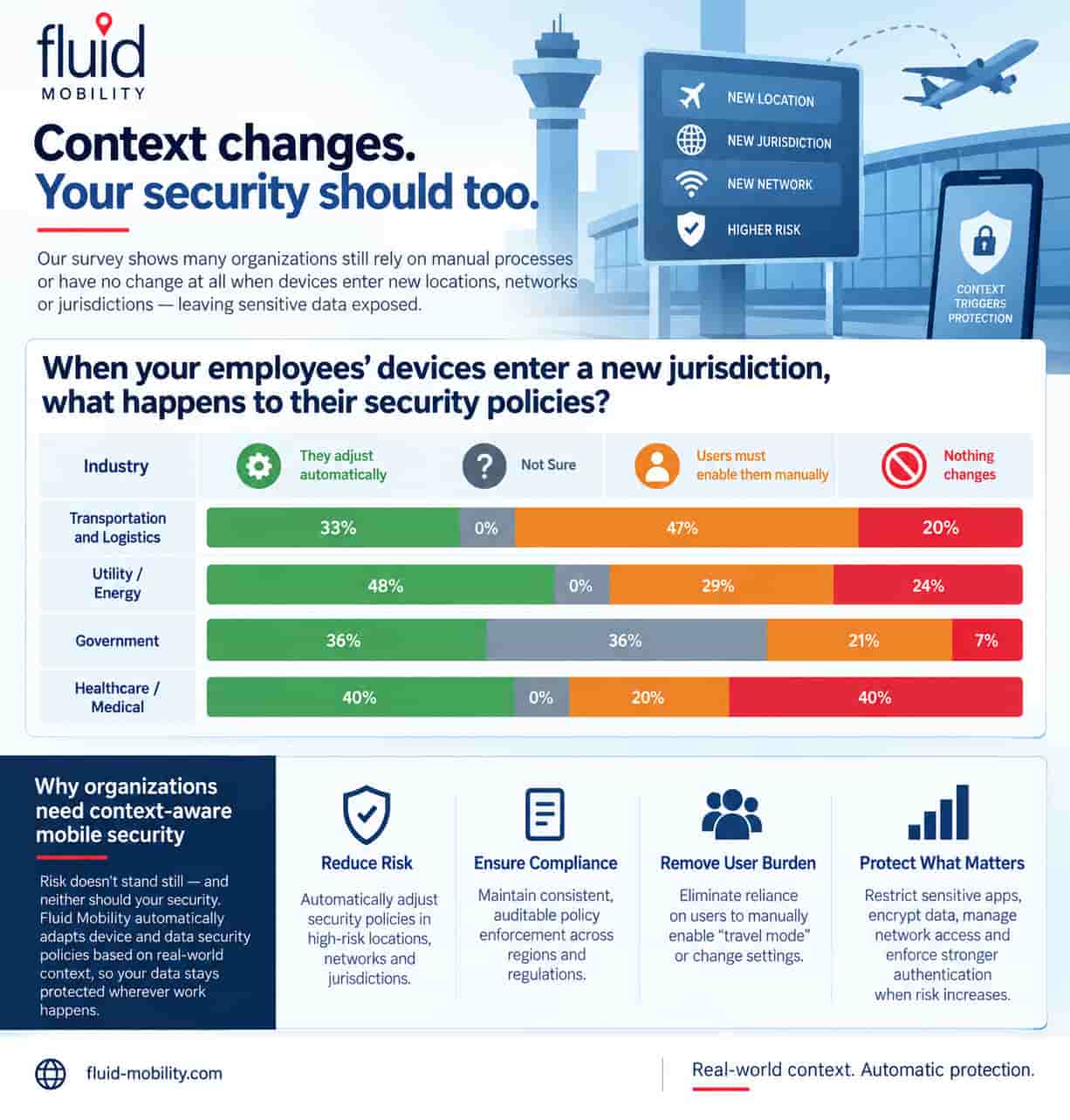
Context-Aware Security Infographic


Automated, context-aware security policies can dynamically adjust device permissions, application and data access, authentication, and network controls based on real-world signals such as location, geofencing, network trust, jurisdiction, time, user role, and device risk. This enables organizations to protect mobile devices, laptops, tablets, and sensitive data with security controls that automatically adapt as operating conditions change. 

See the key terms below:

Term Definition
UEM (Unified Endpoint Management) Software organizations use to centrally manage and secure smartphones, tablets, laptops, and other endpoints.
MDM (Mobile Device Management) Technology used by organizations to remotely configure, secure, monitor, and manage mobile devices.
Geofence / Geofencing A virtual boundary around a real-world location that can trigger an action when a device enters or leaves it.
Context-Aware Security/Policies Security that automatically changes rules based on circumstances such as location, network, time, movement, or user status.
Jurisdictional Exposure Window The period when a device has entered a new legal jurisdiction but its security policies have not yet adapted to that change.
Security Posture The overall state of a device or organization's security protections at a given time.
Policy Enforcement The process of applying and enforcing security rules on a device, such as restricting an app or blocking access to data.
Data Residency Rules or requirements governing where data is physically stored or processed.
PIPEDA Canada's federal private-sector privacy law governing how organizations collect, use, and disclose personal information.
Regulated Data Information subject to legal, regulatory, or industry requirements, such as personal, financial, government, or health information.
Governance The policies, processes, and accountability structures an organization uses to manage risk and meet its obligations.
Audit/Compliance Defensibility An organization's ability to demonstrate with evidence that its security and compliance controls were properly applied.
Risk Zone A location or situation designated as requiring stronger security controls, such as an airport or international border.
Zero-Touch Enforcement Security controls that activate automatically without requiring the user or administrator to take action.
Data Container A protected area on a device that separates and secures organizational data and applications.
On-Premise / On-Premises Technology hosted within an organization's own controlled infrastructure rather than solely in a third-party cloud environment.
Sovereign Deployment / Sovereign Control An approach designed to keep an organization's systems, data, and security controls within its required legal or geographic boundaries.
Contextual Trigger A detected condition such as entering a location, changing networks, or reaching a certain time that automatically initiates a security action.
Policy State A predefined set of security rules applied under particular conditions, such as "Normal Operations" or "Transit Lockdown."
Network Transition When a device moves from one network or carrier to another, such as switching to an international roaming network.
Trusted Network A network an organization has approved as sufficiently secure for particular device or data access.
Data Classification Categorizing information according to its sensitivity so that appropriate security controls can be applied.
Regulatory Mapping Connecting specific security controls and processes to the laws, regulations, or standards an organization must follow.
Device Policy Engine The system that applies security rules to a device based on organizational policies.
Context Engine Technology that evaluates information such as location, network, movement, and time to determine what security actions should occur.
Application & Data Access Controls Rules determining which applications and information a user or device is allowed to access.

Fluid Mobility deploys any combination of geofencing, GPS, Wi-Fi network intelligence, and RTLS/BLE location data to give organizations real-time context about where mobile endpoints are and the environment in which they are operating. The FLUID platform evaluates these contextual signals against predefined risk factors and security rules, then works with the organization’s existing MDM/UEM platform to automatically adjust security policies on mobile devices, tablets, and laptops. 

Importantly, The FLUID platform restricts sensitive applications and data, manages network access, and applies elevated protections when a device enters a high-risk location or jurisdiction such as an airport or border - where device search and confiscation risk are elevated and governance requirements change.  

When trusted conditions are restored, appropriate access can be automatically reinstated, reducing dependence on employees remembering to manually change security settings. This context-aware, zero-touch approach helps organizations maintain a security posture that adapts as risk changes, while creating consistent and auditable policy enforcement that strengthens data protection, governance, regulatory compliance, and overall mobile security.

With Fluid Mobility, automate any policy, anywhere, anytime. 
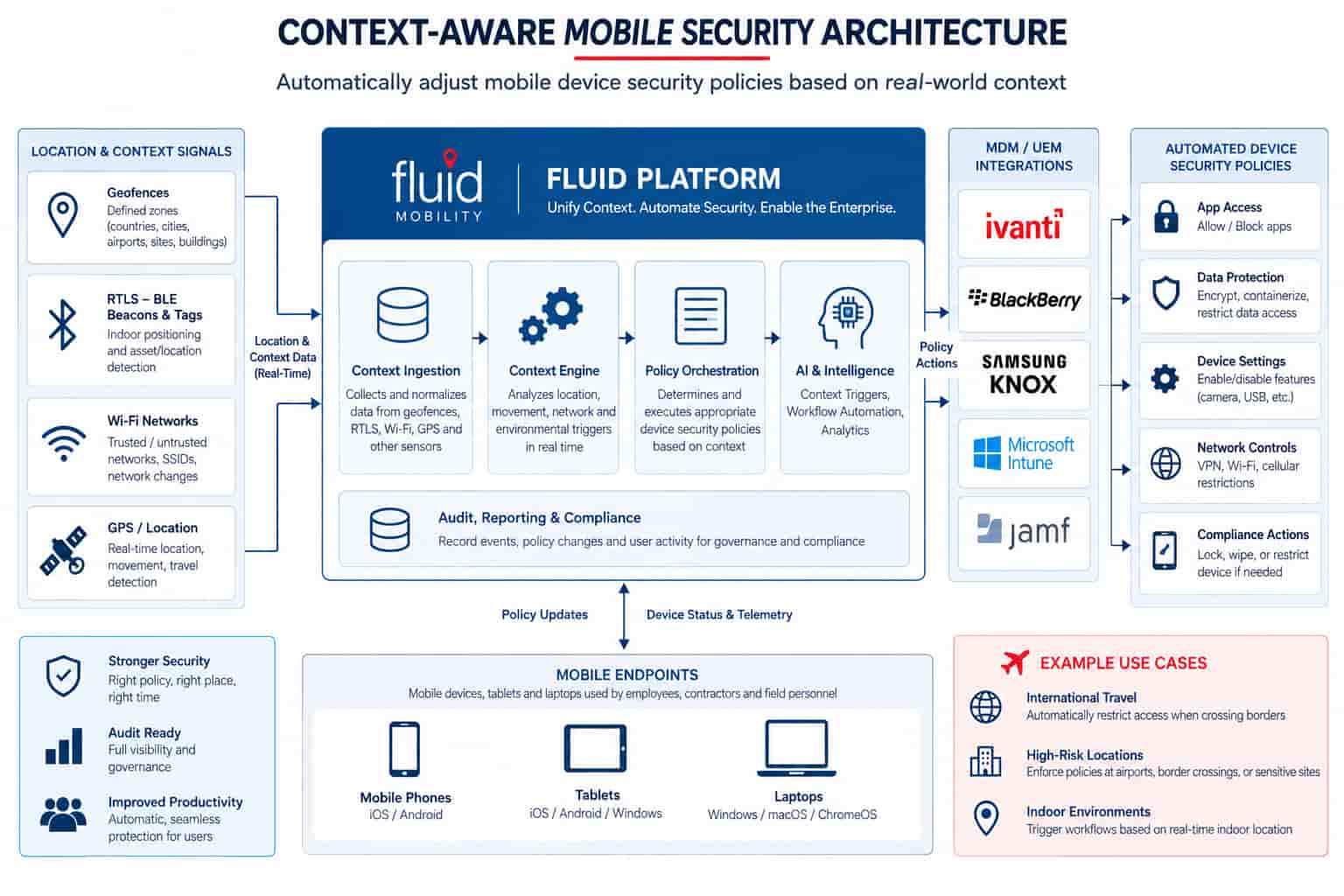
Context-Aware Security Architecture for any organization looking to automate security policies for mobile endpoints, protecting data and helping with auditability and compliance outcomes.

When FLUID detects a change in location, network, jurisdiction, or risk level, it automatically triggers the appropriate device and data security policies through integrated MDM/UEM platforms, enabling organizations to restrict sensitive applications and corporate data, control network access, adjust device capabilities, and apply elevated protections in high-risk environments. As conditions change or devices return to trusted locations and networks, policies can automatically adapt again, providing zero-touch, real-time mobile security enforcement that strengthens data protection, governance, compliance, and audit readiness. 
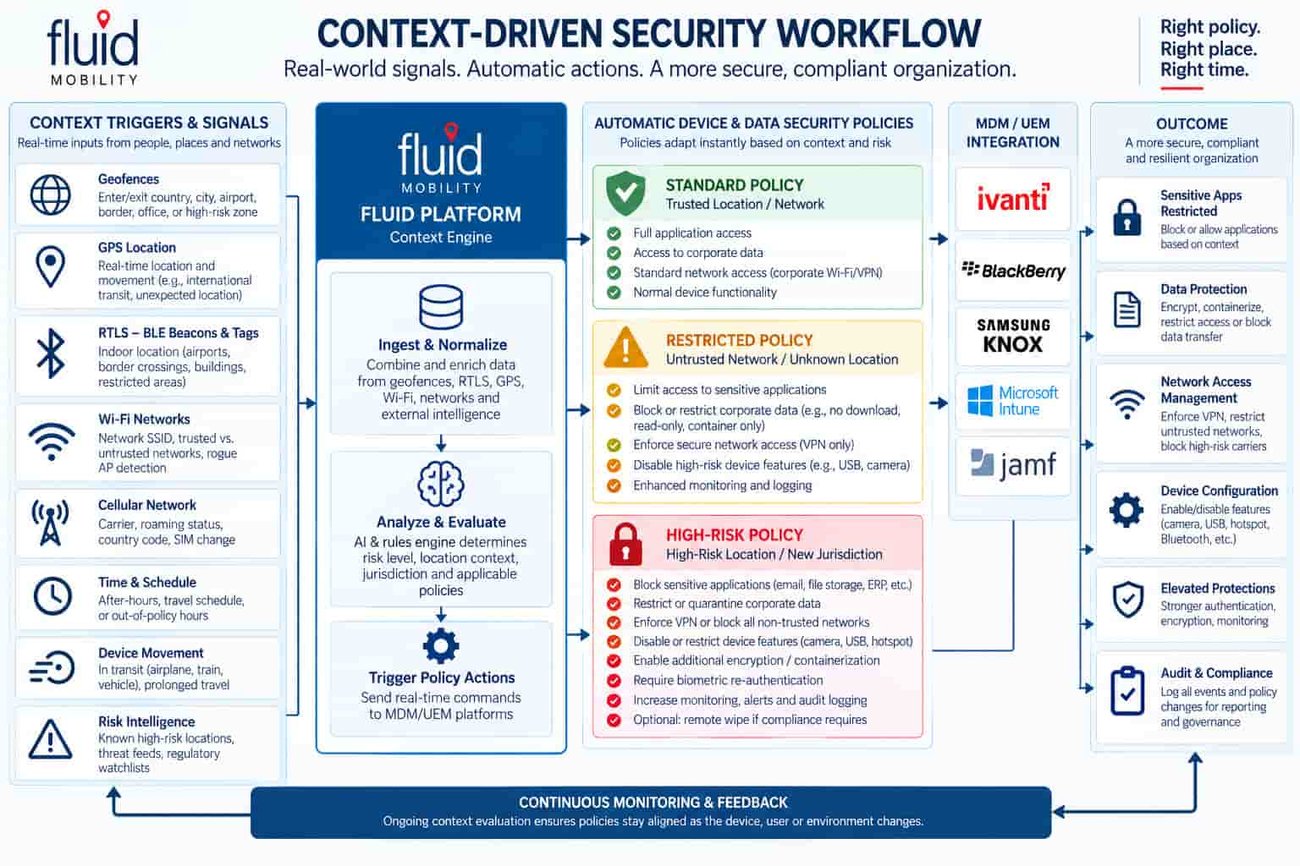
Context Aware Security Workflow detailing how Fluid Mobility's platform uses different signals and context triggers to automate data & device security policies.


Fluid Mobility’s FLUID platform continuously detects and evaluates contextual triggers that indicate changes in a mobile endpoint’s operating environment. The FLUID platform combines these signals in its context engine to determine the appropriate security state and, when predefined conditions are met, uses secure API integrations with the organization’s existing MDM/UEM infrastructure to request the corresponding policy action. 

The MDM remains the enforcement layer, applying policies to managed mobile phones, tablets, and laptops, restricting sensitive applications, limiting or containerizing corporate data, enforcing VPN or trusted-network requirements, disabling device capabilities, requiring stronger authentication, or applying elevated security controls.
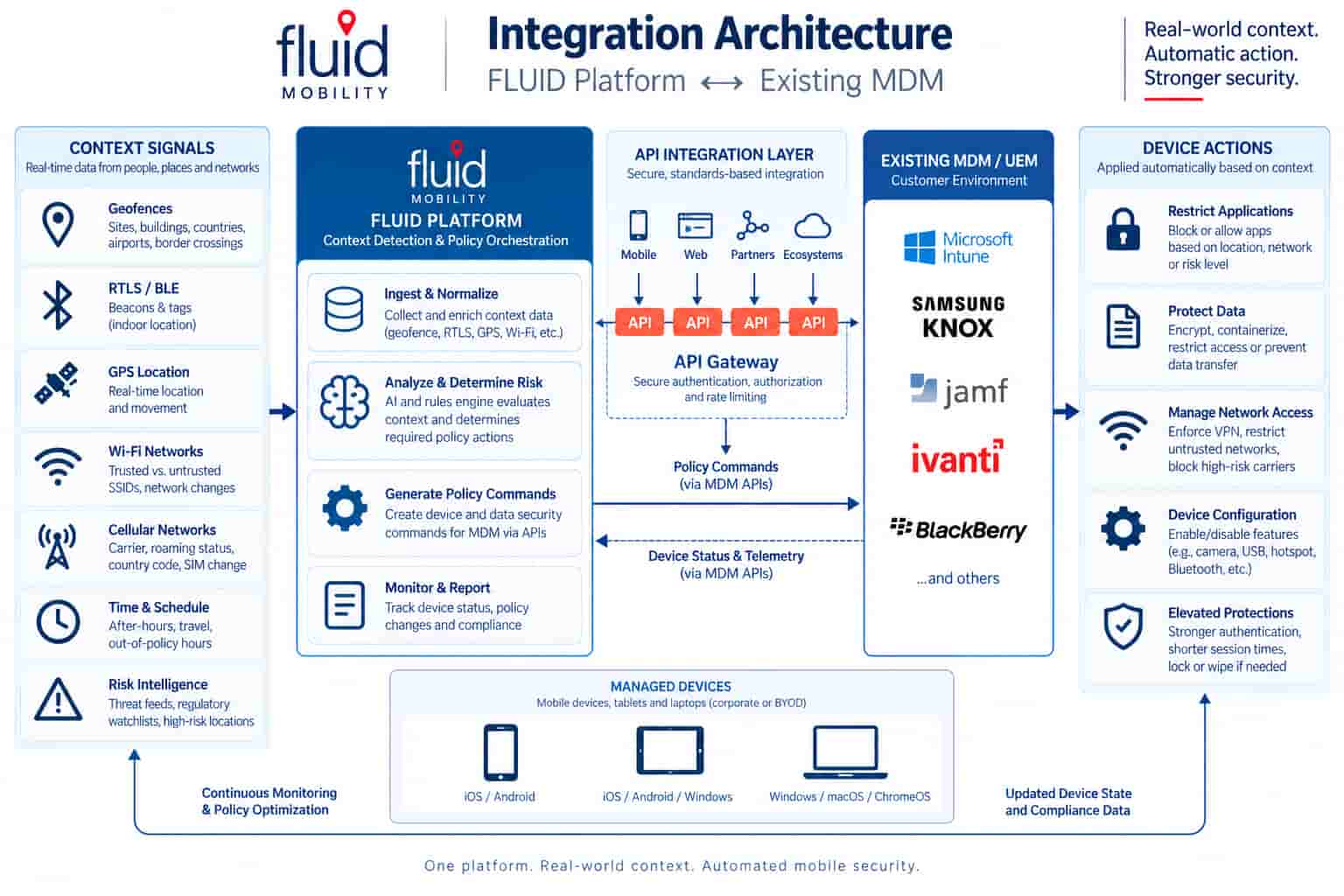
Context Aware Security Integration Architecture showing how the FLUID platform integrates with an organization's existing MDM/UEM with an API.


Fluid Mobility’s context-aware mobile security workflow automatically protects mobile devices, tablets, and laptops as employees enter higher-risk environments such as airports, border crossings, or new jurisdictions. When a device enters a predefined geofence, the FLUID platform evaluates real-time context to automatically initiate device & data security policies via an organization's MDM/UEM.

The FLUID platform automatically restricts sensitive applications, protects or encrypts corporate data, strengthens authentication, manages network access, and adjusts device security settings without requiring any user action. Location, policy changes, and device compliance status are then logged to provide an auditable record of security enforcement, helping organizations strengthen mobile data security, governance, regulatory compliance, and audit readiness.
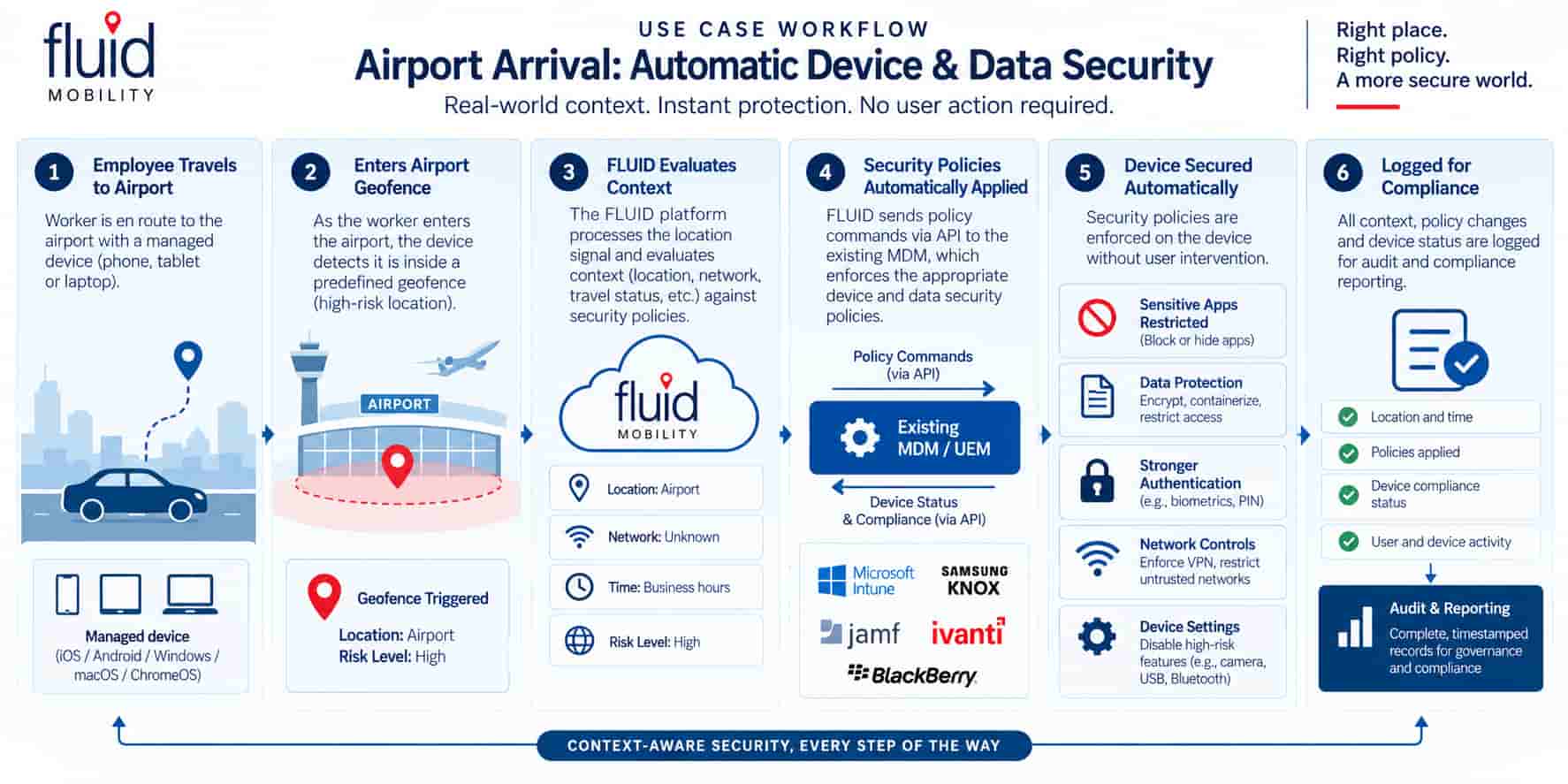
Context-Aware Workflow detailing how the FLUID platform secures devices against data loss and misuse when travelling across borders and jurisdictions.


Frequently Asked Questions

What is context-aware mobile security?

Context-aware mobile security automatically adapts endpoint security according to real-world conditions surrounding a device or user. Signals such as location, geofences, network, time, user role, travel status, and jurisdiction can be evaluated to determine when predefined security policies should change.

How can mobile security policies change based on location?

A managed device can detect or report location information that places it inside or outside predefined geofences. Fluid Mobility can use this contextual change to trigger an appropriate predefined security policy through supported MDM/UEM integrations.

What is jurisdiction-aware mobile security?

Jurisdiction-aware mobile security uses a device's geographic or jurisdictional context as an input to security-policy decisions. Organizations can define different security postures for particular countries, regions, or other geographic contexts based on their own security, governance, and risk requirements.

Can security policies automatically change when employees cross borders?

Yes, where supported location/context signals and integrations are available. A change in geographic or jurisdictional context can trigger a predefined security-policy change without requiring the employee to manually initiate it.

How can organizations protect mobile devices during international travel?

Organizations can define travel-security policies that change application access, data protection, authentication, connectivity, or supported device capabilities as employees move through airports, borders, foreign jurisdictions, and other predefined risk contexts.

Can context-aware security reduce device confiscation or inspection risk?

Context-aware security cannot prevent a device from being inspected or confiscated. It can, however, help organizations reduce the amount of sensitive information or access available on a device when it enters a predefined higher-risk context, subject to the controls supported by their management environment.

That distinction is important and worth keeping explicit.

Can policies differ according to employee role?

Yes. Role can be evaluated alongside other contextual information. For example, an organization may define different travel-security policies for an executive, system administrator, researcher, or general employee based on the organization's risk model.

Does Fluid Mobility replace MDM or UEM?

No. Fluid Mobility is designed to add contextual intelligence and policy orchestration to existing mobile-management infrastructure. Supported MDM/UEM platforms remain responsible for enforcing applicable device and data controls.

What happens when the device returns to a trusted environment?

Fluid can re-evaluate the endpoint's context and trigger the organization's predefined standard policy when the conditions for restoring normal access are satisfied.